Sumikoto
sumi + koto — the clear tongue
A language with the sound and the sentence of Japanese, and a grammar small enough to hold in your head. Roots carry meaning. One-beat particles and endings carry structure. Nothing ever changes shape, and there are no exceptions.
One sentence shape
Every sentence is a row of phrases, each closed by a particle that says what it is doing, and then the predicate. Everything on this site is shown in the script chosen in the sidebar. Hover over any word, or tap it, to see how it is spelled in Latin letters and what the dictionary says; tap a sentence to see its parts.
Roots have no part of speech
kire is “beautiful” before a word, “is beautiful” at the end of a sentence, and “beauty” before a particle. Position does the work that endings do elsewhere.
Particles take anything
yu means “from”. After a place it gives where from; after a whole clause it gives because. The sixteen particles, and one rule for which predicate each phrase belongs to, are the entire syntax.
Eleven endings, one order
tabe eat, tabenuta did not eat, tabetake would have eaten, taberetero may it be being eaten. Any root takes them the same way.
Words build words
nara learn + toko place is naratoko, a school. More than half the dictionary is made this way and can be guessed.
Three ways to write it
Latin letters; hiragana, one sign per beat with no spelling rules; and Sumimozi, a block script where every beat is a consonant stroke over a vowel stroke, and grammar is written small so the skeleton of a sentence shows before you read it.
Bashō's frog, 1686. See Texts for this and six others.
Where to start
Lesson 1 takes ten minutes and ends with real sentences. The grammar is the whole language on one page. The workbench splits anything you type into roots, endings and particles, and glosses every part.
Writing
Sumikoto has 68 beats: the 67 cells of the grid below, and the closing n. That inventory is the kana table as it is spoken today, without di du wi we wo, which a Japanese speaker would hear as zi zu i e o; so hiragana writes the language exactly, one sign per beat. The particles are spelled as they sound. In Latin letters one letter is one sound, and a name takes a capital.
This site shows all Sumikoto in one script at a time, chosen in the sidebar: Sumimozi, kana or Latin. Whichever you read, hovering over a word, tapping it, or reaching it with the Tab key shows its Latin spelling split into parts, and its dictionary entry.
Sumimozi
A block is a consonant stroke drawn over a vowel stroke. The script is systematic in two ways: consonant and vowel are always separate strokes, and a pair of ticks voices a consonant, as the dakuten does in kana: k→g, s→z, t→d, p→b. Beyond that, the ten consonant strokes are simply shapes to learn; unlike Hangul's, they do not picture how a sound is made. Ten consonant strokes and five vowel strokes give every block. A beat that is only a vowel is drawn alone, larger. The same strokes come in three hands, chosen in the sidebar: Block, the plain geometric skeleton; Fine, the same skeleton with a pen's contrast; and Brush, a cursive hand closer to kana.
The fifteen strokes
Roots large, grammar small
Roots are written at full size, particles and endings small. The size alone carries the difference, so the script works in pencil; the red this site uses for grammar only repeats it. Numerals keep full size. A proper name is underlined. Text runs left to right, or top to bottom in columns from the right.
All the beats
Reading aloud
Every beat takes the same time. The first beat of every root is high, also inside a compound, and so is the first beat of a pronoun, a grid word, a number or a name; endings and particles are low. Each high beat is a little lower than the one before, and after a pause the voice starts again from the top. From one high beat to the next there is one root with its endings and particles, which is how a listener hears where words begin. A pause is also grammar: a phrase followed by one belongs to the last predicate of the sentence. si ti tu hu zi may be said plainly or the Japanese way, as shi chi tsu fu ji; nothing depends on the difference.
Sumikoto — reference grammar
Sumikoto (sumi clear + koto speech: "the clear tongue") is a constructed language with the sound and sentence-shape of Japanese and the regularity of a formal system. The whole grammar is on this page. There are no exceptions anywhere in it.
Design in one paragraph: long words carry meaning, one-beat words carry grammar. Every root has at least two beats and never changes shape. Sixteen one-beat particles and eleven one-beat endings do all the grammatical work (the only other one-beat words are the ten digits), and the particles work identically on a word, a phrase or a whole sentence.
Notation: example sentences are written :: sumikoto | English. In Latin letters, capitalised words are proper names and nothing else is capitalised; the other two scripts underline a name instead.
1. Sounds
Five vowels a i u e o, pure and short, as in Japanese, Spanish or Italian. Fourteen consonants k g s z t d n h b p m y r w.
A beat (mora) is a vowel, a consonant + vowel, or the closing nasal n. The full inventory is the Japanese kana table as it is spoken today: no yi, ye, wu, and no di, du, wi, we, wo either, because each of those would sit one breath away from a neighbour (zi, zu, i, e, o). That leaves 67 beats:
| a | i | u | e | o | |
|---|---|---|---|---|---|
| – | a | i | u | e | o |
| k | ka | ki | ku | ke | ko |
| g | ga | gi | gu | ge | go |
| s | sa | si | su | se | so |
| z | za | zi | zu | ze | zo |
| t | ta | ti | tu | te | to |
| d | da | – | – | de | do |
| n | na | ni | nu | ne | no |
| h | ha | hi | hu | he | ho |
| b | ba | bi | bu | be | bo |
| p | pa | pi | pu | pe | po |
| m | ma | mi | mu | me | mo |
| y | ya | – | yu | – | yo |
| r | ra | ri | ru | re | ro |
| w | wa | – | – | – | – |
plus the closing n, which inside a root only occurs after a vowel and before a consonant or the end (hon book, onna woman, genki healthy). Where two roots join and a closing n meets a vowel, the Latin spelling marks the seam with an apostrophe (hon'ie) and the n stays its own beat: hon'ie is ho·n·i·e.
- Every beat takes the same time. taiyo is three beats (ta·i·yo); hon is two (ho·n).
- Pronunciation is free where nothing can be confused. si ti tu hu zi may be said plainly or the Japanese way (shi chi tsu fu ji). r is a light tap. Both accents are correct.
- Melody. The first beat of every root is high, also when the root is the second half of a compound. So is the first beat of a pronoun, a correlative, a number and a name. Endings and particles are always low. Inside a phrase each high beat is a little lower than the one before it, and after a pause the voice starts again from the top.
- This melody is how a listener hears where words begin. From one high beat to the next there is exactly one root, with its endings and its particles. The lexicon is checked by a program so that such a stretch can be cut in only one way: hitosi (equal) has one high beat, hi tosi (one year) has two. A compound and the same two roots said loosely sound alike, and that is intended: the compound is only the pair that the dictionary has given a fixed meaning.
- No sound ever changes. Morphemes are simply placed side by side. When a closing n meets a vowel inside a compound, an apostrophe keeps the Latin spelling honest: hon'ie, hon'ie (book-house, a library).
2. Three ways to write
- Latin letters. One letter, one sound.
- Kana. Because the beat inventory is the kana table, any Sumikoto text can be written in hiragana with one sign per beat, with no spelling rules at all (the particles are written as they sound: わ, お, え). sora wa ao → そら わ あお.
- Sumimozi, the language's own script (sumi + mozi letter): a block script in which each beat is one block built from a consonant stroke over a vowel stroke. It is systematic in two ways: consonant and vowel are always separate strokes, and a pair of ticks turns k s t p into g z d b. The consonant strokes themselves are simply ten shapes to learn. Roots are written large and grammatical beats small, so the structure of a sentence is visible before it is read. The size alone carries that information; the red ink used on the book site only repeats it, so the script works in pencil.
3. Words
| kind | size | examples |
|---|---|---|
| roots (meaning) | 2 to 4 beats | sora sky, kire beautiful, tabe eat |
| particles (role of the phrase before them) | 1 beat, separate word | wa ga o ni e yu ma de to no mo ho ba ka ne sa |
| endings (attached to a root) | 1 beat | -ra -se -re -nu -te -ri -ta -ru -ro -ke -me |
| numerals | 1 beat digits | hi hu mi yo i mu na ya ko |
A root names a concept and has no fixed part of speech. Its position gives it a job:
| position | job | kire | uta | hana |
|---|---|---|---|---|
| last in the sentence | it is asserted | is beautiful | sings | is a flower |
| before another word | it describes that word | beautiful … | singing …, song- | flower-, floral |
| before a particle | it is named | beauty | a song, singing | a flower |
The dictionary marks each root as a thing (n), a quality (a) or an action (v). That mark is not a part of speech: it says what kind of idea the root is, and so what it asserts when it comes last: is an X, is X, does X.
An action root that is named, before a particle, means the act, and by natural extension what the act produces: uta is singing, or a song. Asserted at the end of a sentence it always means the act. To assert the product, lean on mono (thing), or use the passive:
Compounds are a describing word fused with the word it describes, head last, written as one word: nara learn + toko place → naratoko school; nara + hito → narahito student. A compound's meaning is fixed by the dictionary; a loose pair (nara hito, "a learning person") is made up on the spot.
4. The sentence
Sentence = (phrase + particle)… + predicate + (mood particle)
The predicate is always last. Everything before it is a phrase closed by a particle that says what the phrase is doing. Nothing else is needed: no articles, no gender, no agreement, no verb "to be".
Because the particles carry the roles, phrases may come in any order, and anything obvious may be left out:
4.1 The sixteen particles
| meaning | with a word | after a whole clause | |
|---|---|---|---|
| wa | topic | as for … | as for …ing |
| ga | subject | the doer | that … (as subject) |
| o | object | the thing affected | that … (as object) |
| ni | at | place, moment | when … |
| e | to | goal, recipient, beneficiary | in order to … |
| yu | from | source, cause, agent, than | because …, since … |
| ma | until | limit | until … |
| de | with | tool, material, manner, language | by …ing |
| to | and / with | company; the name given to a thing | … and … |
| no | of | links to the next noun | relative clause |
| mo | also, even | X too | although … |
| ho | like | similarity, degree | as …, the way … |
| ba | if | given X | if … |
| ka | question / or | X or … | question; whether … |
| ne | agreement | …, isn't it? | |
| sa | emphasis | …, I tell you! |
This table is the heart of the language. A clause followed by a particle is simply treated as a thing, and the particle means exactly what it always means.
4.2 Topic and subject
ga marks who does it. wa announces what the sentence is about; it can be any phrase, and the comment that follows may have its own ga. When the topic is also the doer, it is not repeated.
wa and mo say how the phrase relates to the conversation, not what its role is, so they can follow another particle; ga and o are simply dropped before them.
4.3 Which predicate a phrase belongs to
A phrase belongs to the nearest predicate after it. Two things reach further, to the last predicate of the sentence:
- a topic, wa, which holds until the end or until the next wa changes the topic;
- any phrase followed by a pause, written as a comma. The pause says: hold this until the end.
So an inner clause is said in one piece, and the outer phrases either follow it or are set off by a pause.
Without the pause, the second sentence would give taiyo ga to the nearest predicate, tuyo. The pause is therefore part of the grammar, in speech as in writing. A comma between two finished statements, or after a free word such as hai, is only a breath.
An inner clause has no topic of its own. Because wa always speaks for the whole sentence, it never stands inside a clause that is closed by a particle (o, no, ni, yu, ba …). What the inner clause is about takes ga, or whatever its role is. A quotation in « » is a sentence in its own right, so it keeps its own wa. Clauses joined by to stand side by side, not one inside the other, so each may have its own wa, as in the example above.
5. Describing
A word placed directly before another describes it. That one rule gives adjectives, adverbs and noun-noun phrases.
no links anything looser: a possessor, a longer phrase, or a whole clause (the relative clause). The describing part always comes first.
Places are built from position nouns with no … ni: dai no ue ni on the table, ie no naka ni inside the house, ame no ato ni after the rain, nemu no mae ni before sleeping.
6. Endings
Eleven endings. Ten of them stack in this order; each is optional, and none changes the root.
| slot | ending | meaning | tabe eat |
|---|---|---|---|
| 0 | -ra | plural (things; only when it matters) | nekora cats |
| 1 | -se | causative: make/let | tabese feed |
| 2 | -re | passive | tabere be eaten |
| 3 | -nu | not | tabenu doesn't eat |
| 4 | -te / -ri | ongoing / done-and-standing | tabete is eating, taberi has eaten |
| 5 | -ta / -ru | past / future | tabeta ate, taberu will eat |
| 6 | -ro / -ke | wish, command / unreal, supposed | tabero eat!, tabeke would eat |
No ending in slot 5 means "now, or whenever" — time is marked when it matters, not by obligation. Endings attach to whatever word is last, whether thing, quality or action:
-ro is one mood for every person: with you it commands, with we it proposes, with anything else it wishes. warera wa ikuro "let's go"; ame ga owaro "may the rain end".
-ke marks a statement as not real: what would happen, or would have happened, under a condition that does not hold. Without it, a condition is an open one.
The eleventh ending, -me, makes ordinals from numerals: hime first, mime third.
Endings belong to roots. A pronoun or a correlative takes only -ra and -nu (karera they, soyonu not so); for anything else it leans on a root: koko ni aruro be here!
7. Verb chains
Since a word describes the word after it, "want to eat" is just eat-wise want: the main verb comes first and the helper root comes last, taking the endings. Any root with a suitable meaning can be a helper.
| tabe hori | want to eat | hori want |
| tabe eru | can eat | eru be able |
| tabe beki | must eat | beki must |
| tabe yuru | may eat | yuru allow |
| tabe hazime | start eating | hazime begin |
| tabe owa | finish eating | owa end |
| tabe tuzu | keep eating | tuzu continue |
| tabe tamesi | try to eat | tamesi try |
| tabe sugi | eat too much | sugi exceed |
| tabe yasu | easy to eat | yasu easy |
| tabe rasi | seems to eat | rasi seem |
8. Questions
Add ka. Nothing moves. Question words stay where the answer would be.
Answers: hai yes, iya no, or just repeat the predicate: iku. / ikunu.
9. The correlative table
Six stems × seven endings. Every cell exists and means what its row and column say.
| thing -re | which -no | person -na | place -ko | time -ki | manner -yo | amount -ho | |
|---|---|---|---|---|---|---|---|
| this ko- | kore | kono | kona | koko | koki | koyo | koho |
| that so- | sore | sono | sona | soko | soki | soyo | soho |
| which? do- | dore | dono | dona | doko | doki | doyo | doho |
| some a- | are | ano | ana | ako | aki | ayo | aho |
| every mi- | mire | mino | mina | miko | miki | miyo | miho |
| no nu- | nure | nuno | nuna | nuko | nuki | nuyo | nuho |
koki now, miki always, nuki never, dona who, doyo how, doho how many. "Why" is dore yu (from what); "what kind of" is doyo no. A do- word with mo means any: doko mo anywhere at all.
Pronouns use the same -re: ware I, nare you, kare he/she; with -ra, warera we, narera you all, karera they. onore is "self" for every person; tagai is "each other". Possession is no: ware no my.
Sentence connectors are built from sore and a particle, and mean exactly what they say: sore yu therefore (from that), sore mo however (even so), sore to and also, sore ba in that case, sore ma until then.
10. Numbers
ze 0, hi 1, hu 2, mi 3, yo 4, i 5, mu 6, na 7, ya 8, ko 9; so 10, momo 100, sen 1 000, yoro 1 000 000. A digit before a power multiplies it; groups are then just said in order.
Numbers describe like any other word (mi neko), with no counters. A number never stands alone before a particle; with nothing else to describe, it describes mono: hi mono o age give one. "Three times" is mi ori. Clock hours and months are ordinals: mime toki three o'clock, hume tuki February.
11. Comparison
yu (from) is than; ho (like) is as … as; nao more, sai most.
12. Small print
- Having: ware ni neko ga aru "at me there is a cat", or ware wa neko o moti.
- Names keep their capital (in kana and Sumimozi, their underline) and take san for respect: Aiko san.
- Quoting: put the words in « » and treat them as a thing: «iku» o iuta "(he) said 'I'm going'".
- Naming: the name stands with to, because a thing and its name go together: hikari o «hiru» to yobita "(he) called the light 'day'"; kare o Ken to yobi "(they) call him Ken".
- Free words: an interjection or a sentence adverb may stand alone before a comma: hai, iku. tabun, koinu. nagi! (peace! — hello and goodbye).
- Grouping: when a string of describing words could be read two ways, no closes the group: ito oki no yama.
- No double negatives: a nu- word already carries the negation, so the predicate stays positive: nuna ga koita no one came.
- What -nu denies is its whole clause, with every phrase in it. mina ga koinuta is "it is not so that everyone came", that is, not everyone came. "No one came" is nuna ga koita.
- to binds tighter than no. Aiko to Ken no neko is the cat of Aiko and Ken, and a describing clause before a pair joined by to describes both. To describe only one, say it last: Ken to ware ga miyuta no hito.
- How one knows is said with words, not endings: koiru rasi (he) will come, it seems; «koiru» o kikita (I) heard that (he) will come.
- Tense in an inner clause is counted from the time of the outer clause: koiru o iuta "said (he) would come".
- Long numbers take -me on their last word: so hime eleventh. Minutes follow the hour: mime toki huso hun 3:20.
- Than with actions: add nao and the reading is unambiguous: Ken yu nao haya kake runs faster than Ken.
- Who is met, where one arrives: au takes to (meet with); todo, iri, nobo take e.
- The one made to act by -se is marked e: haha ga kodo e nemuseta the mother put the child to sleep.
- A one-word clause looks like a noun (ame mo "rain too" or "though it rains"). Context decides; an ending settles it: amete mo though it is raining.
13. Why it parses
Every sentence has the same shape, so a listener never has to guess the role of a word:
- a one-beat word is a particle and closes the phrase before it (the ten digits are the one exception: they are one beat and describe the next word like any root);
- inside a phrase, each word describes the next, and the last one is the head;
- what follows the last particle is the predicate, and its endings come in a fixed order;
- a phrase belongs to the nearest predicate after it; a topic (wa) and a phrase followed by a pause belong to the last.
The lexicon is built to keep this true: no root is ever another root plus an ending or a particle, so tabeta can only be tabe + -ta. The validator in tools/sk.py checks that property for all entries, and checks the words and endings of every example in this grammar and in the textbook. It also checks that no root sounds like a shorter root with endings and particles after it, and runs a syntax pass over every example: it attaches each phrase by rule 4 and reports a predicate that receives two ga or two o phrases, a sentence that ends on a role particle, and a bare number before a particle. The command sk.py parse prints the attachment it finds. The pass cannot tell whether a noun before a particle is itself the predicate of an inner clause, so rule 2 and rule 4 still leave some sentences to the listener's sense; the program catches the common slips, not all of them.
Lesson 1 — Sounds and the first sentence
The idea of the lesson. A sentence names what it is about, then says one thing about it. There is no verb "to be": the last word is the statement.
Dialogue
Aiko and Ken meet on the path outside the school.
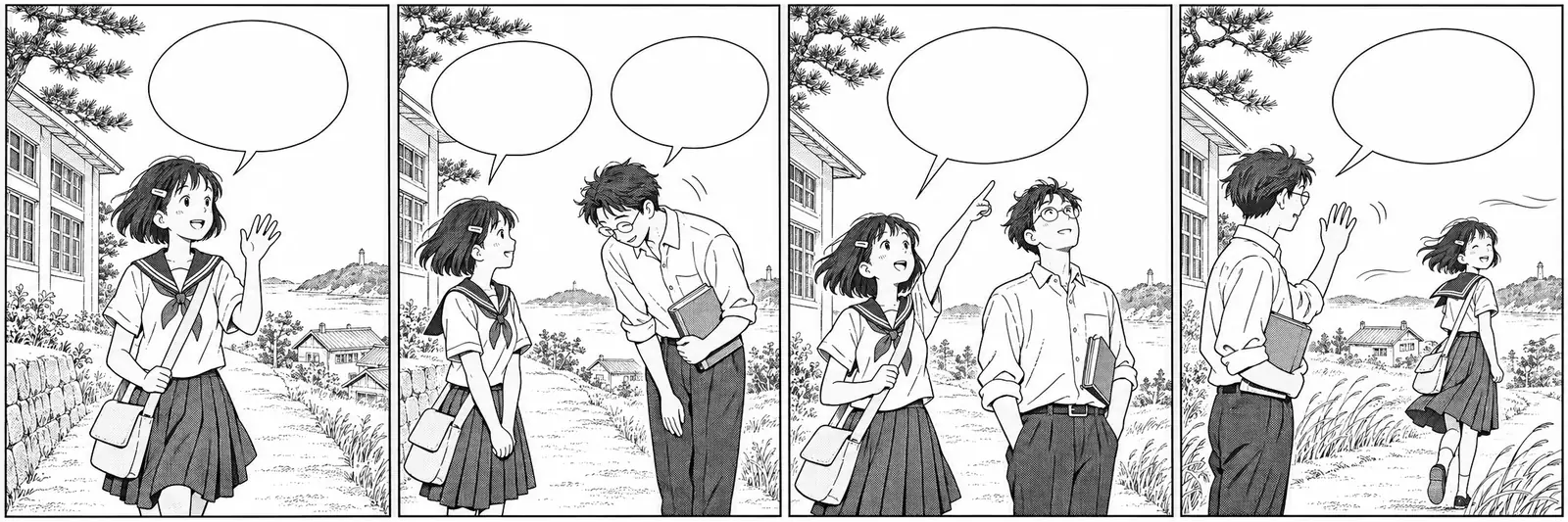 nagi!ware wa Aiko.ware wa Ken.sora wa ao.nagi, Aiko san!
How it works
The sounds
This book shows Sumikoto in the script chosen in the sidebar: Sumimozi, kana or Latin letters. Hover over any word, or tap it, to see its Latin spelling and its meaning. The signs are taught on the Writing page; until you know them, read with Latin letters or lean on the hover.
Sumikoto has five vowels, a i u e o, short and pure, as in Japanese or Italian. It has fourteen consonants, k g s z t d n h b p m y r w, and r is a light tap of the tongue.
The unit of sound is the beat: a vowel alone, a consonant plus a vowel, or a closing n. The whole inventory is the kana table as it is spoken today: no yi, ye or wu, and no di, du, wi, we or wo either, since those would sound like zi, zu, i, e, o. That leaves 67 beats, plus the closing n. Every beat takes the same time, so taiyo (sun) is three beats, ta·i·yo, and hon (book) is two, ho·n. Because the beats are the kana, you can write any Sumikoto in hiragana with one sign per beat and no spelling rules: sora wa ao is そら わ あお.
Where nothing could be confused, pronunciation is free: si ti tu hu zi may be said plainly or the Japanese way (shi chi tsu fu ji). Both are correct, and both will be understood.
The melody is simple. The first beat of every root is high, and so is the first beat of a pronoun (ware), a number or a name. Endings and particles are low. Each high beat is a little lower than the one before it, and after a pause the voice starts again from the top. The high beats are how a listener hears where words begin: from one high beat to the next there is exactly one root, with its endings and particles. In sora wa ao, so and a are high, and everything else is low.
Nothing ever changes shape. When a closing n meets a vowel inside a compound, the Latin spelling takes an apostrophe to keep the beats apart: hon'ie, hon'ie (book-house, a library), is ho·n·i·e, not ho·ni·e. Kana and Sumimozi write beat by beat and need no such mark.
Long words mean, short words work
Every word that carries meaning — a root — has at least two beats: sora sky, kire beautiful, tabe eat. The particles and endings, which do the grammar, have exactly one. In the sentence sora wa ao, the one-beat wa is grammar; the two-beat words around it are meaning. You can hear the structure before you know a single word. Two kinds of word stand apart: the ten digits are one beat but carry meaning, and the pronouns such as ware are two beats but belong to the grammar. Both start on a high beat, like roots.
The first sentence: X wa Y
wa marks the topic: as for X. Whatever comes last is said about it.
Notice what is missing. There is no "is", no "a" or "the", no agreement. ao is not an adjective waiting for a verb; placed last, it asserts: "is blue". The sentence is complete.
Roots have no part of speech
A root names a concept. Its position gives it a job. Last in the sentence, it is asserted; before a particle, it is named as a thing. Take uta, the concept of singing:
And kire, the concept of beauty:
The dictionary marks each root as a thing (n), a quality (a) or an action (v) only to tell you what it means when it comes last: is an X, is X, or does X. hito last means "is a person"; ao last means "is blue"; uta last means "sings". There is one word in each case, not three.
Greetings and small words
nagi means peace, calm. Said alone it is the greeting for both meeting and parting — the same word at the door coming in and going out. arigato is thanks, gomen is sorry or excuse me, hai is yes, iya is no. These are free words: they can stand alone, or before a comma at the head of a sentence: hai, sora wa kire.
Names keep their capital letter in Latin spelling and are underlined in kana and Sumimozi; san after a name adds respect: Aiko san.
Thinking in Sumikoto
A Sumikoto speaker does not hunt for the right verb. The thought has two steps:
- Choose what you are talking about, and close it with wa.
- Say the one thing you want to say about it, and stop.
Hold the frame ware wa … and let the last slot change:
Now hold the last word and change the topic:
A thing, a quality and an action all fill the same slot in the same way. That is the first small idea, and it does a great deal of work: you can already say anything of the form "X is Y" or "X does Y" with every root in the dictionary.
Vocabulary
| word | meaning |
|---|---|
| nagi | peace; hello, goodbye |
| arigato | thank you |
| gomen | sorry, excuse me |
| hai | yes |
| iya | no |
| wa | topic particle: as for … |
| san | respectful title after a name |
| ware | I, me |
| hito | person |
| narahito | student |
| osiehito | teacher |
| sora | sky |
| umi | sea |
| yama | mountain |
| kawa | river |
| kaze | wind |
| hana | flower |
| taiyo | sun |
| ao | blue |
| kire | beautiful |
| taka | high, tall |
| suzu | cool |
| genki | healthy, well |
| makoto | truth; true |
| uta | sing; song |
Exercises
- Count the beats: taiyo, hon, kokoro, hon'ie, genki.
- Translate into English: umi wa kire.
- Translate into English: Ken wa osiehito.
- Translate into English: taiyo wa taka.
- Translate into Sumikoto: I am a student.
- Translate into Sumikoto: The wind is cool.
- Translate into Sumikoto: Aiko sings.
- Fill the particle: yama __ taka.
- Build a sentence: take the topic hana and say three different things about it, using kire, ao and uta.
- What does uta mean in each position? (a) uta wa kire. (b) Ken wa uta.
Answer key
- taiyo 3 (ta·i·yo); hon 2 (ho·n); kokoro 3; hon'ie 4 (ho·n·i·e); genki 3 (ge·n·ki).
- The sea is beautiful.
- Ken is a teacher.
- The sun is high.
5.
6.
7.
8. wa
9.
The last one is odd, but perfectly grammatical — and a poet might want it.
- (a) named before a particle: the song. (b) asserted last: sings.
Lesson 2 — Doing things
The idea of the lesson. A one-beat particle after a phrase says what that phrase is doing in the event. Once every phrase wears its role, order is free and anything obvious can simply be left out.
Dialogue
Aiko and Ken at a table in the school garden.
How it works
The doer and the thing done
The last word of a sentence is its predicate. Every phrase before it is closed by a particle that tells you its role. Two particles do most of the work for actions:
- ga marks the doer: the one who acts, or the one described.
- o marks the thing affected: what the action is done to.
Because the roles are carried by the particles, the phrases may come in any order. The predicate stays last; everything else moves freely, and the meaning does not change.
Moving a phrase to the front gives it a little weight, the way stress does in English, but nothing about who did what is ever in doubt.
Topic and doer
wa from Lesson 1 says what the sentence is about. ga says who does it. Often they are the same person, and then the topic is not repeated: ware wa uo o tabe is "I eat fish". But the topic can be anything — even the thing eaten — and the comment after it may have its own doer:
ga and o are simply dropped before wa. A phrase cannot be both "the thing affected" and "what we are talking about" with two particles at once; wa wins, and context tells you the rest.
Leaving out the obvious
A sentence needs only its predicate. Everything else is there when it is useful.
In the dialogue Aiko answers hai, tabe — "yes, eat". She does not say who, because both of them know. This is not a shortcut or a casual register: it is how the language is built.
Questions with ka
To ask, add ka at the end. Nothing moves.
Answer with hai or iya, or by repeating the predicate: tabe ka? — tabe.
A question word stands exactly where the answer will stand. dore means what? or which?:
The answer is the question with dore replaced. You can check an answer by laying it over the question.
This, that, which
kore is this thing, sore is that thing (near you, or just mentioned), dore is which thing? All three end in -re, "thing". Look again at the pronouns: ware I, nare you, kare he or she. Same ending. In Lesson 6 you will see that this is one column of a table you can build yourself.
One caution for lovers of Japanese: the fourth member of the family, are, means something, not "that over there". Distance has two steps in Sumikoto, here (ko-) and there (so-).
Thinking in Sumikoto
Building an action sentence is a matter of tagging each participant as it comes to mind.
- Who are we talking about? → Aiko wa
- What is affected? → hon o
- What happens? → yomi
Now let the frame generate. Change the thing affected:
Make the thing affected the topic, and give the doer ga:
Ask about any slot by putting dore in it:
Remove whatever the listener already knows:
Every one of these sentences is made by the same move: a phrase, a particle, and the predicate at the end.
Vocabulary
| word | meaning |
|---|---|
| ga | doer particle |
| o | thing-affected particle |
| ka | question particle |
| nare | you |
| kare | he, she |
| kore | this (thing) |
| sore | that (thing), it |
| dore | what? which? |
| tabe | eat |
| nomi | drink |
| yomi | read |
| kiki | hear, listen |
| taki | cook |
| hon | book |
| pan | bread |
| uo | fish |
| tiya | tea |
| mesi | food, meal |
| mizu | water |
| neko | cat |
| inu | dog |
| haha | mother |
| titi | father |
Exercises
- Translate into English: inu ga mizu o nomi.
- Translate into English: hon wa titi ga yomi.
- Translate into English: kore wa dore ka?
- Translate into Sumikoto: The mother cooks fish.
- Translate into Sumikoto: Do you drink tea?
- Translate into Sumikoto: What does the dog eat?
- Fill the particles: neko __ uo __ tabe.
- Fill the particles: pan __ Ken __ tabe. (Ken eats the bread; the bread is the topic.)
- Build a sentence: give two different orders of Ken reads the book, both correct.
- Shorten as far as the situation allows. A friend holds up a cup and asks tiya o nomi ka? Answer "yes" in two words.
Answer key
- The dog drinks water.
- The book — father reads it. / Father reads the book.
- What is this?
4.
5.
6.
7. ga, o
8. wa, ga
9.
10.
Lesson 3 — Describing
The idea of the lesson. A word placed directly before another word describes it. That single rule gives you adjectives, adverbs and noun-noun phrases; no links anything looser, and fusing two words makes a new one.
Dialogue
Aiko visits Ken's house for the first time.
How it works
Before means "describing"
Lesson 1 showed two positions: last (asserted) and before a particle (named). The third position is directly before another word. There a root describes the word after it.
Look at what is not needed. There is no separate class of adjectives: oki is "big" whether it describes or is asserted (yama wa oki, the mountain is big). There is no separate class of adverbs: haya before a thing means "fast", before an action it means "fast-ly". There is no special construction for noun-noun phrases: yama before miti makes a mountain road. One rule, three traditional parts of speech.
The describing word can be a thing, a quality or an action, and the thing described can be any of the three as well:
ito, very
ito is a root like any other, meaning "very". Put it before what it intensifies:
Each word describes the next
Inside a phrase, each word describes the one after it, and the last word is the head. In ito oki yama, ito describes oki and oki describes yama. This reads easily from left to right: every word narrows what comes next.
Sometimes a string could be grouped two ways. no then closes a group: ito oki no yama is unambiguously "a (very big) mountain". The same device gives two separate descriptions of one thing:
Strictly, oki aka hana makes oki describe aka. In everyday speech nobody minds, because a flower of a big redness is a big red flower all the same; no is there for the times the grouping matters.
no, of
no links any looser phrase to the noun after it: a possessor, a place, a whole longer phrase. The describing part, as always, comes first.
There is no word for "my" or "your": ware no is "of me", nare no is "of you". The pronouns are ordinary things, and no treats them like any other.
The difference between the bare and the linked form is one of closeness. neko ie is a cat-house, a kind of house; neko no ie is the cat's house, a house that happens to belong to a cat.
Compounds
A describing word fused with the word it describes, written as one word, is a compound. Its head is last, like everything else:
A compound is a loose pair that the dictionary has fixed. nara hito, written apart, is made up on the spot: "a person who is learning", anyone at all. narahito is the word for a student. Spoken, the two sound alike: the second root of a compound starts on a high beat too, so both are ná·ra·hí·to. Only the dictionary, and the context, tell them apart. You will often be able to guess a compound before you meet it, and the dictionary only has to tell you which guesses have been made official.
Thinking in Sumikoto
When a Sumikoto speaker wants a more exact thing, she does not reach for a new word; she puts a describer in front.
Start with a head: tori, a bird. Narrow it, one word at a time, from the right:
That last step shows why you should think from right to left when stacking: tisa describes kuro. Close the group:
Now make it belong to someone, and put it in a sentence:
Exactly the same steps work for actions. Start with ayu, walk:
And for qualities:
One rule, applied to anything, from either side of a sentence.
Vocabulary
| word | meaning |
|---|---|
| no | of; links a phrase to the next noun |
| ito | very |
| oki | big |
| tisa | small |
| huru | old (not new) |
| ara | new |
| yosi | good |
| waru | bad |
| aka | red |
| kuro | black |
| siro | white |
| oho | many, much |
| tika | near |
| toho | far |
| haya | fast |
| yasasi | kind, gentle |
| sizu | quiet |
| ie | house |
| niwa | garden |
| miti | road, path |
| tori | bird |
| tomo | friend |
| ayu | walk |
| kake | run |
| nemu | sleep |
| nara | learn |
| osie | teach |
| naratoko | school |
| hon'ie | library |
| toko | place |
| utahito | singer |
| tabetoko | restaurant |
Exercises
- Translate into English: siro neko wa ito tisa.
- Translate into English: Ken no haha wa yasasi hito.
- Translate into English: kare wa sizu yomi.
- Translate into Sumikoto: a very old house
- Translate into Sumikoto: My friend's dog runs fast.
- Translate into Sumikoto: The school is far.
- Fill the particle: ware __ tomo __ narahito. (My friend is a student.)
- Build a word: what would uta + hito mean as a compound? And tabe + toko?
- Build a phrase: say a big white bird, making sure oki describes the bird and not the colour.
- Explain the difference between neko ie and neko no ie.
Answer key
- The white cat is very small.
- Ken's mother is a kind person.
- She reads quietly.
4.
5.
6.
7. no, wa
8. A singer (utahito) and a restaurant, an eating place (tabetoko). Both are in the dictionary.
9.
10. neko ie is a cat-house, a kind of house (made for cats); neko no ie is the house of a particular cat.
Lesson 4 — Where
The idea of the lesson. Four particles map all of space: ni at, e to, yu from, ma as far as. Everything finer — on, under, inside, behind — is an ordinary noun linked with no.
Dialogue
Ken has lost his cat. Aiko helps him look.
How it works
Four directions
Every place in a sentence is one of four kinds, and each has its particle:
| particle | meaning | example |
|---|---|---|
| ni | at, in, on — where something is or happens | uti ni at home |
| e | to, toward — the goal | mati e to town |
| yu | from — the source | yama yu from the mountain |
| ma | until, as far as — the limit | kawa ma as far as the river |
They combine freely, since each phrase carries its own role:
ni covers both "where something is" and "where something happens". You sit ni a place and you study ni a place:
e is the goal of any movement, and giving is a movement: the person who receives is the goal of the gift.
There is: aru
aru means "exist, be somewhere". It works for everything: stones, cats, people, gods.
These are the same sentence with the phrases in a different order. English needs two constructions ("the cat is…", "there is a cat…"); Sumikoto has one, and order only moves the weight.
A warning for readers of Japanese: there is no separate verb for living beings, and Japanese iru is not a Sumikoto word. aru covers both.
Position nouns
"On", "under", "inside" are not particles. They are nouns — names for regions of space — and they take no like any noun:
So a place is built in three layers: the thing (dai), the region of it (dai no ue), and the role of that region in the event (dai no ue ni). You already know every piece. Because mae and ato mean front and back, they will also give you before and after in Lesson 5, with nothing new to learn.
Here and there
koko here, soko there, doko where? They are places, so they take place particles:
Having
Sumikoto says "have" in two ways, both made from words you know.
The first presents the cat as existing in your sphere; the second presents you as holding it. Use whichever fits the thought.
Thinking in Sumikoto
A Sumikoto speaker builds a place from the inside out, the way you would point at it.
- What is the landmark? → kigi
- Which part of it? → kigi no ue
- What is its role? Is something there, going there, coming from there? → kigi no ue ni
- Then the event → tori ga kigi no ue ni aru.
Change only step 3, and the same place serves a different event:
Change step 2:
Change step 1, and it is a different world:
Four particles and a handful of nouns cover all of space.
Vocabulary
| word | meaning |
|---|---|
| ni | at, in, on |
| e | to, toward; for (recipient) |
| yu | from |
| ma | until, as far as |
| aru | exist, be (somewhere) |
| moti | hold, have |
| koko | here |
| soko | there |
| doko | where? |
| ue | top; above, on |
| sita | bottom; under |
| naka | inside |
| soto | outside |
| mae | front; before |
| ato | back, behind; after |
| yoko | side; beside |
| aida | the space between |
| iku | go |
| koi | come |
| kae | return, go back |
| hane | jump |
| tobi | fly |
| age | give |
| uti | home |
| mati | town |
| heya | room |
| dai | table |
| isu | chair |
| yane | roof |
| kado | gate, door |
| kigi | tree |
| hosi | star |
| tete | hand |
Exercises
- Translate into English: hon wa dai no ue ni aru.
- Translate into English: Ken wa uti yu naratoko e ayu.
- Translate into English: ware ni inu ga aru.
- Translate into Sumikoto: The cat is under the chair.
- Translate into Sumikoto: Aiko goes to the library.
- Translate into Sumikoto: There is a garden behind the house.
- Fill the particles: tori ga yama __ kawa __ tobi. (The bird flies from the mountain to the river.)
- Fill the particles: kado __ mae __ inu ga aru. (There is a dog in front of the gate.)
- Build a sentence: say I have a book in both ways.
- Where is it? neko wa mado no yoko ni aru.
Answer key
- The book is on the table.
- Ken walks from home to school.
- I have a dog.
4.
5.
6.
7. yu, e
8. no, ni
9.
10. The cat is beside the window (mado, window).
Lesson 5 — When
The idea of the lesson. Time is marked by small endings on the last word, and only when it matters. Numbers are digits said in order, and "the third" is simply three with -me.
Dialogue
Aiko meets Ken on the morning path.
How it works
Two slots for time
The endings of Sumikoto sit in a fixed order. This lesson uses two neighbouring slots: first the shape of the event, then its place in time.
| shape (slot 4) | time (slot 5) | ||
|---|---|---|---|
| -te | ongoing: in the middle of it | -ta | past |
| -ri | done, and the result stands | -ru | future |
Each ending is optional, and they combine in that order:
That is the whole tense system: two choices of two, multiplied. No ending in the time slot means "now, or whenever": Sumikoto marks time when it matters, not by obligation. If a time word already says when, the bare form is enough.
-ri deserves a moment. It describes a state produced by an event: hana ga sakuri, "the flowers have bloomed" — and are in bloom now. kado o akeri is "(I) have opened the door", and it stands open.
The endings go on whatever word is last, whatever kind of root it is:
ame is "rain"; as a predicate with -te, "it is raining". There is no separate verb.
Time words
asa morning, hiru day, yube evening, yoru night; maehiru yesterday (the day before), atohiru tomorrow (the day after); kono hiru today, "this day". koki is now and soki then; doki asks when?
A time word is an ordinary noun, so it obeys the describing rule. At the start of a sentence it needs a particle, or it would describe the next word:
Directly before the predicate, it describes the predicate itself, and needs nothing:
The same is true of mou already, mada still, sugu soon and mata again: put them directly before the word they qualify, which is usually the predicate.
Before and after are the position nouns mae and ato:
Numbers
| ze 0 | hi 1 | hu 2 | mi 3 | yo 4 | i 5 | mu 6 | na 7 | ya 8 | ko 9 |
|---|
The powers are so 10, momo 100, sen 1 000 and yoro 1 000 000. A digit fused before a power multiplies it; the groups are then said in order, largest first.
Numbers describe like any other word, and there are no counters:
A number never stands alone before a particle: it always describes a word. When there is nothing else for it to describe, it describes mono, "thing":
The reason is the sound. A digit is one high beat and a particle one low beat, so mi o would sound exactly like a two-beat root, high then low. With mono after it, a number is always followed by another high beat, and the listener hears it as a word of its own.
Clock and calendar
Add -me to a number and it becomes an ordinal: hime first, hume second, mime third. The ending goes on the last word of the number, as endings always do: so hime eleventh.
Clock hours and months are ordinals — the third hour, the second moon:
A plain number counts a length of time instead:
So mime toki ma nemuta is "slept until three o'clock", and mi toki nemuta is "slept for three hours". The -me is the whole difference between a point and a length.
Thinking in Sumikoto
Start with the bare event, and add only what the listener needs.
Is it past? Add -ta. Was it in progress? Put -te before it:
When? Add a time phrase, closed by its particle:
Now keep the frame and change the event:
Or keep the event and slide it along the time line:
Three independent choices — shape, time, and a time phrase — and every combination is a sentence.
Vocabulary
| word | meaning |
|---|---|
| -te | ongoing |
| -ri | done, with standing result |
| -ta | past |
| -ru | future |
| -me | ordinal |
| ze hi hu mi yo i mu na ya ko | 0–9 |
| so momo sen yoro | 10, 100, 1000, 1 000 000 |
| koki | now |
| soki | then |
| doki | when? |
| asa | morning |
| hiru | day |
| yube | evening |
| yoru | night |
| maehiru | yesterday |
| atohiru | tomorrow |
| toki | time; hour |
| hun | minute |
| tuki | moon; month |
| tosi | year |
| haru natu momi huyu | spring, summer, autumn, winter |
| asamesi | breakfast |
| yubemesi | supper |
| mou | already |
| mada | still |
| sugu | soon |
| mata | again |
| nasu | do |
| same | wake up |
| au | meet |
| saku | bloom |
| ake | open |
| ame | rain; to rain |
| samu | cold |
| atu | hot |
Exercises
- Translate into English: maehiru ni Ken wa tiya o nomiteta.
- Translate into English: hana ga sakuri.
- Translate into English: atohiru ni ameru.
- Translate into Sumikoto: I will go to town tomorrow.
- Translate into Sumikoto: The children were sleeping at ten o'clock. (Use kodo child.)
- Translate into Sumikoto: The summer was hot.
- Say in Sumikoto: 14, 58, 700, 1999.
- Fill the particle or ending: asa __ mizu o nomi__. (In the morning I drank water.)
- Build two sentences that differ only by -me: I slept until four o'clock / I slept for four hours.
- Why does asa need ni in asa ni tiya o nomi, but not in tiya o asa nomi?
Answer key
- Yesterday Ken was drinking tea.
- The flowers have bloomed (and are in bloom).
- It will rain tomorrow.
4.
5.
6.
7.
(sen alone is a thousand, just as so alone is ten.)
8. ni, -ta
9.
10. A bare word describes the word after it. In tiya o asa nomi, asa stands directly before the predicate and describes it: "morning-drink". At the start of the sentence, bare asa would describe tiya ("morning tea"), so it needs ni to become a time phrase of its own.
Lesson 6 — Not, also, and, or
The idea of the lesson. Negation is one ending, and "also", "and", "or" are three particles that work on anything. The words for who, where, never, everyone are not a list to learn: they are a grid you can build.
Dialogue
Aiko and Ken at the morning market.
How it works
-nu, not
-nu is the negative ending. It sits in slot 3, before the time endings you know, and negates whatever is last:
With -ri, "the result does not stand" means not yet:
Since it is an ending, -nu always negates its own clause, the predicate with every phrase in it, and never anything outside. You will see in Lesson 7 how this makes the scope of "not" exact.
mo, also and even
mo adds a phrase to what has already been said: this too. Like wa, it speaks about the phrase's place in the conversation rather than its role, so ga and o drop before it, and other particles stay:
Twice, it means both; with a negative predicate, neither:
The second sentence is exact: "fish too, meat too: not buying". English needs a special word; Sumikoto only needs the two you already have.
to, and / with
to joins things, and it marks company. These are one idea: things that go together.
ka, or
Between alternatives, ka means or:
This is the same ka as the question. A question is a pair of alternatives with the second left open: iku ka? is "going, or…?"
The grid
You have met kore, sore, dore, koko, doko, koki. They are cells of one table. Six beginnings say which one:
- ko- this, so- that, do- which?, a- some, mi- every, nu- no
Seven endings say what kind of thing:
- -re thing, -no which (before a noun), -na person, -ko place, -ki time, -yo manner, -ho amount
Every combination exists and means exactly what its parts say:
| thing -re | which -no | person -na | place -ko | time -ki | manner -yo | amount -ho | |
|---|---|---|---|---|---|---|---|
| this ko- | kore | kono | kona | koko | koki | koyo | koho |
| that so- | sore | sono | sona | soko | soki | soyo | soho |
| which? do- | dore | dono | dona | doko | doki | doyo | doho |
| some a- | are | ano | ana | ako | aki | ayo | aho |
| every mi- | mire | mino | mina | miko | miki | miyo | miho |
| no nu- | nure | nuno | nuna | nuko | nuki | nuyo | nuho |
Read any cell aloud and you have its meaning: nuki is "no-time", never; mina "every-person", everyone; ako "some-place", somewhere; doyo "which-manner", how? Forty-two words, thirteen pieces. Keep place, time and amount apart by their last beat: -ko, -ki, -ho.
Like the pronouns, these words take only two endings, -ra and -nu: soyonu "not so". For any other ending, lean on a root: koko ni aruta, "(I) was here".
Two phrases complete the table. do- with mo means any at all: doko mo anywhere, dona mo anyone. Why is dore yu, "from what"; what kind of is doyo no.
Notice how negation works here. In nuna ga koita, the "no" is inside the word: no-one came. The predicate stays positive, because the sentence asserts something about a person who is nobody.
Do not build "no one came" from mina and -nu. The ending denies its whole clause, everyone included: "it is not so that everyone came".
Thinking in Sumikoto
The grid turns questions and answers into one operation: swap the first beat.
Ask with do-:
Answer by replacing do- with whatever you know:
The same move works in any column:
A speaker never memorises "never, nowhere, nobody, nothing". She thinks no + time, no + place, and the word is already there.
Vocabulary
| word | meaning |
|---|---|
| -nu | not |
| mo | also, even; X mo Y mo both … and |
| to | and; with |
| ka | or (between alternatives) |
| dona | who? |
| mina | everyone |
| nuna | no one |
| ana | someone |
| mire | everything |
| nure | nothing |
| miki | always |
| nuki | never |
| doyo | how? |
| doho | how much, how many? |
| iti | market |
| niku | meat |
| sake | wine, alcohol |
| kai | buy |
| uri | sell |
| urihito | seller, shopkeeper |
| kodo | child |
(The rest of the grid needs no list: build it.)
Exercises
- Translate into English: Ken wa uti ni arunu.
- Translate into English: Ken wa tiya mo sake mo nominu.
- Translate into English: mina ga Aiko to uta.
- Translate into Sumikoto: I didn't buy bread.
- Translate into Sumikoto: Nobody is at home.
- Translate into Sumikoto: Do you go to the market or to the library?
- Build from the grid: somehow, that much, every …, sometime.
- Fill the particle: inu __ neko __ niwa ni aru. (A dog and a cat are in the garden.)
- Fill the particle: mati e __ ikunu. (To town, too, I'm not going.)
- Answer dore o tabeta ka? in four ways: this, something, everything, nothing.
Answer key
- Ken is not at home.
- Ken drinks neither tea nor wine.
- Everyone sings with Aiko.
4.
5.
6.
7. ayo, soho, mino, aki.
8. to, ga
9. mo
10.
Lesson 7 — Verb chains
The idea of the lesson. "Want to eat" is just eat-wise want: the main verb describes the helper after it. The describing rule you already know gives you every modal verb, and the endings go on the helper.
Dialogue
Aiko and Ken on a hot summer day.
How it works
The helper comes last
You know that a word before another word describes it: haya kake, "fast-run". Put an action before another action, and the first describes the second:
The helper is the predicate; the main verb in front of it says what kind of wanting, what kind of ability. Since the helper is last, it takes the endings:
Everything the main verb acts on stays with it, in front:
The helpers
Any root with a suitable meaning can be a helper. These are the ones you will use every day:
| chain | meaning | helper |
|---|---|---|
| tabe hori | want to eat | hori want |
| tabe eru | can eat | eru be able |
| tabe beki | must eat | beki must |
| tabe yuru | may eat | yuru allow |
| tabe hazime | start eating | hazime begin |
| tabe owa | finish eating | owa end |
| tabe tuzu | keep eating | tuzu continue |
| tabe tamesi | try to eat | tamesi try |
| tabe sugi | eat too much | sugi exceed |
| tabe yasu | easy to eat | yasu easy |
| tabe muzu | hard to eat | muzu difficult |
| tabe rasi | seem to eat | rasi seem |
None of these is a special verb. hori alone means "want" (kane o hori, wants money); owa alone means "end" (yoru ga owata, the night ended). They become helpers by standing second.
They work after qualities and things too, because the rule does not care what kind of root is in front:
Chains of helpers
Helpers stack, and they read the way describers do: each one takes everything before it.
Read from the right: hazimeta began — what? tamesi, trying — trying what? tabe, eating. Swap two words and you swap the meaning, exactly.
The scope of "not"
Because -nu goes on the last word, it negates the whole chain:
To negate only the going, make it a clause of its own and want that. (Lesson 8 shows clauses as things; here is a preview.)
The same precision separates two senses that English blurs in "must not":
Thinking in Sumikoto
Start with the event:
Now ask what stance you take toward it, and add that stance after it:
Put tense and negation on the last word, wherever the chain ends:
Then add one more stance, and the chain grows at the right end:
Every link is the same move: X-wise Y. A learner of Sumikoto never studies modal verbs, only words.
Vocabulary
| word | meaning |
|---|---|
| hori | want |
| eru | can, be able |
| beki | must |
| yuru | allow; may |
| hazime | begin |
| owa | end, finish |
| tuzu | continue |
| tamesi | try |
| sugi | exceed; too … |
| yasu | easy |
| muzu | difficult |
| rasi | seem |
| oyo | swim |
| ike | pond |
| kane | money |
| kaki | write |
| hanasi | speak; talk |
| koto | language |
| sumikoto | the Sumikoto language |
Exercises
- Translate into English: Ken wa yama ni nobo hori.
- Translate into English: kono hon wa yomi muzu.
- Translate into English: kodo wa ama mesi o tabe sugita.
- Translate into Sumikoto: I can write Sumikoto.
- Translate into Sumikoto: Aiko didn't want to sleep.
- Translate into Sumikoto: The children began to sing.
- Translate into Sumikoto: It seems too far.
- Fill the ending: ware wa koki tabe hori__. (I don't want to eat now.)
- Build two sentences: (I) tried to start reading and (I) started trying to read.
- Which sentence says you are not obliged to wait, and which says you are not allowed to? matu bekinu. / matu yurunu.
Answer key
- Ken wants to climb the mountain.
- This book is hard to read.
- The child ate too much sweet food.
4.
5.
6.
7.
8. -nu
9.
10. matu bekinu — no obligation (you don't have to wait). matu yurunu — not allowed (you may not wait).
Lesson 8 — Sentences as things
The idea of the lesson. A whole clause followed by a particle is treated as a thing, and the particle means what it always means. "That …", "whether …" and "the person who …" are not new constructions; they are o, ka and no.
Dialogue
Aiko has been reading. Ken knows the author.
How it works
A clause is a thing
Until now, the phrase before a particle was a word or a group of words. It can also be a whole clause — everything up to and including its own predicate. Followed by a particle, the clause is simply a thing, and the particle gives it its role.
The second sentence is the first one, plus o, plus a new predicate. The clause is the object of miyuta, as uo is the object of tabeta. "That" is not a word in Sumikoto; it is the shape of the sentence.
Quotations work the same way. Put the words in « » and they are a thing:
Any particle can close a clause. With ga the clause is the subject; with wa, the topic:
One piece at a time
A phrase belongs to the nearest predicate after it. Two things reach further, to the last predicate of the sentence: a topic with wa, and any phrase followed by a pause, written as a comma. This rule tells you how to arrange a sentence with a clause inside it: say the inner clause in one piece, and put the outer phrases around it or set them off with a pause.
Here Ken ga belongs to koita, the nearest predicate. Aiko wa reaches past it to miyuta. If you wrote Aiko ga instead, it too would attach to koita, and the clause would have two doers. When the main doer is not the topic, put it after the inner clause:
Or keep it in front and pause after it. The pause says hold this until the end:
The pause is grammar, not decoration: without it, Aiko ga would go to koita. It works for any phrase. Without the pause here, kodo e would belong to kaita: "the book I bought for the child".
A comma between two complete statements, or after a free word like hai, is only a breath.
"The person who …": no
You know no links a phrase to the noun after it: ware no neko. It links a clause just as easily. The result is a relative clause, and the noun fills whatever slot the clause has left open.
In the first line miyuta has a doer (ware ga) but no object, so the person is the one seen. In the second it has an object but no doer, so the person is the one who saw. Nothing marks the gap; it is simply the role that is missing.
A relative clause can be a single word, and it can carry any ending. This is how a description gets a tense or a "not":
"Whether …", "what …": ka o
A question followed by o is an indirect question:
Each is a direct question — kare ga koiru ka? — turned into a thing with o.
Thinking in Sumikoto
Make a plain sentence first:
Now treat it as a block and do things with it. Know it:
Leave one slot open, and point at what fills it:
Put a ka on it and wonder:
And the blocks fit inside each other, because each new clause is just another thing:
Nothing in this lesson is new grammar. The particles were already able to take any thing; a sentence is a thing.
Vocabulary
| word | meaning |
|---|---|
| siru | know |
| iu | say |
| toi | ask; question |
| kotae | answer |
| miyu | see |
| sumu | live (somewhere) |
| suki | like |
| tanosi | fun, interesting |
| ani | brother |
| imo | sister |
| mei | name |
| « » | quotation marks |
Exercises
- Translate into English: ware wa Aiko ga utata o siru.
- Translate into English: Ken ga takita no mesi wa oisi.
- Translate into English: dona ga koiru ka o sirunu.
- Translate into Sumikoto: the cat that ate the fish
- Translate into Sumikoto: the fish the cat ate
- Translate into Sumikoto: I asked what Ken wants.
- Translate into Sumikoto: Mio said "I'm tired". (daru tired)
- Fill the particles: Aiko __ Ken __ nemute __ miyuta. (Aiko saw that Ken was sleeping.)
- Fix the sentence so that Aiko is the one who knows: Aiko ga Ken ga koiru o siru.
- Build a relative clause from kare wa uti ni sumu, so that it means "the home where he lives".
Answer key
- I know that Aiko sang.
- The meal Ken cooked is delicious.
- I don't know who will come.
4.
5.
6.
7.
8. wa, ga, o
9.
Or, keeping ga, put Aiko after the inner clause:
Or keep the order and add a pause after Aiko ga:
10.
Lesson 9 — The same particles on clauses
The idea of the lesson. "Because", "if", "when", "although", "in order to", "until" and "by" are not words to learn. They are the particles you already know, placed after a clause instead of after a noun.
Dialogue
A rainy afternoon. Aiko and Ken are at Aiko's house.
How it works
One table, read twice
Here is part of the particle table from the grammar. The left column is what you have been using with nouns. The right column is the same particle after a clause.
| particle | after a noun | after a clause |
|---|---|---|
| yu | from | because, since |
| ba | given X | if |
| ni | at (a place, a moment) | when |
| mo | also, even | although, even if |
| e | to (a goal) | in order to |
| ma | until, as far as | until |
| de | with, by means of | by …ing |
Each line is one meaning. A cause is where an event comes from. A purpose is where an action is going. "When" is the moment the main event is at. "By doing" is the tool you used. Once you see the clause as a thing, the right column needs no memorising at all.
What closes the clause is the particle. The comma after it is the pause from Lesson 8: it sends the clause to the last predicate of the sentence. In these short sentences the main predicate is the only one left, so the pause changes nothing; in longer ones it is what keeps the clause with the main event.
Shape of the sentence
The rule from Lesson 8 still decides who belongs to what: a phrase belongs to the nearest predicate after it, unless it is a topic or is followed by a pause. So everything inside the "because" or "if" clause goes before its particle, in one piece, and the main clause follows:
Ken ga belongs to koi; ware wa, being a topic, reaches the end. If you want the topic to cover the whole sentence, you may also put it first: ware wa, Ken ga koi ba, uresi.
Before and after
These are not particles but position nouns, from Lesson 4. A clause links to them with no, like any description:
Connectors: sore + particle
To link two separate sentences, refer back to the first one with sore, "that", and add the particle. Every connector is a literal phrase:
| connector | literally | meaning |
|---|---|---|
| sore yu | from that | therefore, so |
| sore mo | even that | however, even so |
| sore ba | given that | in that case |
| sore ma | until that | until then |
| sore to | and that | and also |
Thinking in Sumikoto
Take one main sentence and keep it fixed:
Now build a circumstance — any clause — and decide what relation it has to the going. That decision is one particle:
Then a second step: any of these may itself contain a clause.
You never decide which conjunction to use from a list. You decide what the clause is to the event — its source, its goal, its limit, its condition — and the particle says it.
Vocabulary
| word | meaning |
|---|---|
| ba | if |
| de | with, by means of; by …ing |
| sore yu | therefore |
| sore mo | however, even so |
| sore ba | in that case |
| sore ma | until then |
| sore to | and also |
| dore yu | why? |
| matu | wait |
| todo | arrive, reach |
| tutome | work |
| aso | play |
| uresi | happy, glad |
| kana | sad |
| daru | tired |
| kanga | think; thought |
Exercises
- Translate into English: daru yu, sugu nemuta.
- Translate into English: Aiko ga koi ba, mina ga uresi.
- Translate into English: samu mo, kodora wa soto ni aso.
- Translate into Sumikoto: I went to the library to read.
- Translate into Sumikoto: When Ken came, I was sleeping.
- Translate into Sumikoto: I learned Sumikoto by speaking with Aiko.
- Fill the particle: tutome owa __, ware wa uti ni kaeru. (Until I finish working, I won't go home — careful: change the predicate too.)
- Fill the particle: yamai __, naratoko e ikunuta. (Because I was ill, I didn't go to school.)
- Join with a connector: It's cold. Therefore I'm staying at home.
- Build four sentences around ware wa uti ni aru with four different clause particles.
Answer key
- Because (I) was tired, (I) slept at once.
- If Aiko comes, everyone will be happy.
- Although it's cold, the children play outside.
4.
5.
6.
7. ma, and the predicate becomes negative:
8. yu
9.
10. For example:
Lesson 10 — Voice and wishes
The idea of the lesson. Three endings turn an event around: -re makes the affected thing the subject, -se adds someone who causes it, and -ro wishes it into being — as a command, a proposal or a hope. A fourth, -ke, says that it is not real: it would be, or would have been.
Dialogue
A Saturday morning at Aiko's house. Emi is her mother; Taro is her little brother.
How it works
Four endings, three slots
The endings you will learn here sit at the beginning and the end of the chain:
| slot | ending | meaning | with tabe |
|---|---|---|---|
| 1 | -se | make or let happen | tabese feed (make eat) |
| 2 | -re | be done to | tabere be eaten |
| 6 | -ro | wish, command, proposal | tabero eat! |
| 6 | -ke | unreal: would, would have | tabeke would eat |
With the endings you already know, the full order is: -ra -se -re -nu -te/-ri -ta/-ru -ro/-ke. With -me from Lesson 5, you have now met all eleven.
-re: being done to
-re turns the event so that the thing affected is the subject. The doer, if you mention it, is the source of the action, so it takes yu, "from":
-se: making it happen
-se adds a causer. The causer is the new subject; the person who actually does the action is the one the action is given to, so it takes e:
-se attaches to qualities as easily as to actions. "Make clean" is simply the quality clean with -se:
The two endings combine, in slot order:
-ro: let it be so
-ro is one mood for every person. Who the subject is decides how it sounds:
With you, a command; with us, a proposal; with anything else, a wish. It is one idea: I want this to be so. With -nu before it, it forbids:
It goes on the last word, so in a chain it goes on the helper: tabe tamesiro, "try eating!"
-ke: if it were so
A condition with ba (Lesson 9) is open: it may or may not hold. When you know it does not hold, put -ke on the main predicate. The condition keeps its plain form.
-ke shares slot 6 with -ro, so it comes after everything else. With -ta before it, the unreal is in the past: koike would come, koitake would have come. With -nu: ikunutake, "(I) would not have gone".
There is no ending for how you know something. Say it with a root: koiru rasi "(he) will come, it seems", or «koiru» o kikita "(I) heard that (he) will come".
Asking and offering: nega and dozo
A bare -ro is direct. Two free words, set before a comma, make it polite — and they point in opposite directions.
nega means "wish, beg". Before a request it is please: I ask something for myself.
dozo is please, go ahead, here you are: I offer something to you.
nega is also an ordinary root, so it can take a clause as its object:
Thinking in Sumikoto
Start with a plain event and its two participants:
Now ask: from whose side am I telling this? From the fish's:
Is someone behind it? Add a causer, and the cat moves to e:
Is it a fact or a wish? Change the last ending:
Each step changes one ending and, at most, one particle. The participants stay the same; only the point of view moves.
Vocabulary
| word | meaning |
|---|---|
| -se | causative: make, let |
| -re | passive: be done to |
| -ro | wish, command, let's |
| -ke | unreal: would, would have |
| -ra | plural |
| nega | wish, beg; please |
| dozo | please, go ahead, here you are |
| warera | we |
| narera | you (several) |
| karera | they |
| kiyo | clean, pure |
| kitana | dirty |
| kura | dark |
| yami | darkness |
| hikari | light |
| toru | take |
| sinzi | believe, trust |
| mado | window |
| sime | close, shut |
| ake | open |
Exercises
- Translate into English: kono uta wa mina yu sirure.
- Translate into English: titi ga Taro e mado o simeseta.
- Translate into English: warera wa uti e kaero.
- Translate into Sumikoto: Please close the door.
- Translate into Sumikoto: The bread was eaten by the dog.
- Translate into Sumikoto: The teacher made the children write.
- Translate into Sumikoto: Don't eat that.
- Fill the ending: hon wa Ken yu kaki__. (The book was written by Ken.)
- Fill the free word: __, isu ni suwaro. (Please, have a seat — you are offering.)
- Build three sentences from kodo ga nemu: a wish, a command to the child, and a causative with the mother as causer.
- Translate into English: kane ga aru ba, sono ie o kaike.
- Translate into Sumikoto: If it had rained, I would not have gone.
- Make it unreal: Ken ga koita ba, ware wa uresita. (Ken did not come.)
Answer key
- This song is known by everyone.
- Father had Taro close the window.
- Let's go home.
4.
5.
6.
7.
8. -reta
9. dozo
10.
11. If I had money, I would buy that house.
12.
13. -ke on the main predicate:
Lesson 11 — Comparing and measuring
The idea of the lesson. To compare, say where you measure from: yu is "than". To match, say what it is like: ho is "as". Amounts come from the grid (doho, koho) and from the numbers you already know.
Dialogue
After the school race. Ken ran; Aiko watched.
How it works
Than: yu
yu means from. A comparison measures one thing starting from another, so the standard of comparison takes yu, and the quality is the predicate:
No "-er" ending and no "more" is needed: taka is "high", and "high from the hill" is "higher than the hill". To deny the comparison, negate the predicate as usual: oka yu takanu, not higher than the hill.
As: ho
ho means like. "As fast as the wind" is "fast like the wind":
More and most: nao, sai
When the standard is not named, nao "more" describes the quality, and sai "most" picks out the top:
The range — "of all", "among them" — is a place, so it is built with a position noun:
There is no word for "less". You say it with what you have: nao suko, "fewer"; or with -nu: oka yu takanu, not higher than the hill.
Comparing actions
A phrase belongs to the nearest predicate after it, and that is worth remembering here. In a sentence whose predicate is an action, a yu phrase belongs to the action, and yu with an action means from: Ken would be where the running starts. So when you compare how people act, make the quality the predicate. Either compare the people:
or turn the actions into things, and compare those:
This is a little longer than English, and entirely clear: the thing measured, the reference point, and the quality, each in its own slot.
If you do want the action last, add nao. "More" makes the comparison explicit, and yu can only be than:
How much: the -ho column
The amount column of the grid (Lesson 6) does the measuring. doho asks how much, how many; koho and soho answer this much, that much. Before another word, like any describer, they say how much of it:
A number can end a sentence, as here, or describe a word, but it never stands alone before a particle (Lesson 5). To say "(I) bought two", give it mono to describe: hu mono o kaita.
Age is a number of years:
Times, halves, ordinals
ori is an occasion, so a number before it counts occasions: mi ori three times, doho ori how many times? han is half: pan no han, half of the bread.
-me makes ordinals (Lesson 5): hime first, hume second, mime third. They describe like any number:
haka measures and kazoe counts. Both are ordinary verbs:
Thinking in Sumikoto
Every comparison starts from a plain statement of quality:
Then you choose one of three relations, and each one is a single particle or word:
- measured from something → yu
- like something → ho
- at the top of a range → sai, with the range as a place
Hold the relation and change the quality:
Or ask about the amount instead:
A comparison is a description with a reference point, and the reference point is a phrase like any other.
Vocabulary
| word | meaning |
|---|---|
| ho | like, as |
| nao | more |
| sai | most |
| koho | this much |
| soho | that much |
| ori | occasion; times |
| han | half |
| kazu | number |
| haka | measure |
| kazoe | count |
| nari | become |
| tabun | maybe |
| naga | long |
| mizika | short |
| omo | heavy |
| karu | light (not heavy) |
| tuyo | strong |
| yowa | weak |
| waka | young |
| oso | slow; late |
| tabi | journey |
| oka | hill |
Exercises
- Translate into English: umi wa ike yu oki.
- Translate into English: kono neko wa inu ho omo.
- Translate into English: kore ga sai ama.
- Translate into Sumikoto: My father is older than my mother. (oi aged)
- Translate into Sumikoto: How many books do you have?
- Translate into Sumikoto: I read that book three times.
- Translate into Sumikoto: Ken is not as fast as Taro.
- Fill the particle: natu wa haru __ atu. (Summer is hotter than spring.)
- Translate into Sumikoto: Of these three books, this one is the longest.
- Answer with an ordinal: dono hito ga hime ka? — Taro is the first.
Answer key
- The sea is bigger than the pond.
- This cat is as heavy as a dog.
- This one is the sweetest.
4.
5.
6.
7.
8. yu
9.
10.
Lesson 12 — Reading
The idea of the lesson. You now know the whole grammar; what remains is words. This lesson is a story, a poem and one page that holds everything you have learned.
A story: «umi no iro»
The colour of the sea. Read it aloud once before you read the notes. Each sentence uses only what you have met in Lessons 1–11.
Notes on the story
- Line 1. ano is "a certain" — the some row of the grid — not "that". The whole long place phrase umi no yoko no ano mura ni is built from Lesson 4: landmark, region, no, particle.
- Line 2. No ending: the past is already clear from line 1, and Sumikoto marks time only when it matters. Lines 4–6 do the same.
- Line 3. miki "always" stands directly before the predicate it describes. Placed before umi, it would have described the sea ("an always-sea").
- Line 7. An indirect question (Lesson 8): yoru no umi ga dono iro ka is the question "which colour is the night sea?", made into a thing with o. sore mo is the connector "even so".
- Line 8. A quotation is a thing, and the quoted command keeps its own -nu-ro.
- Line 9. sizu describes ideta: quietly-left. Compare line 3: a describer goes directly before what it describes.
- Line 10. tuki mo hosi mo with a negative predicate: neither moon nor star.
- Line 11. kurata is a quality with -ta; kuro rasita is a chain, "black-wise seemed".
- Line 14. oho nari hazimeta: three roots, each describing the next, the endings on the last. Read it from the right: began — to become — many.
- Line 15. ho "like" gives as … as; the plural -ra on hosira is there because it matters.
- Line 16. A thought, like a quotation, is a thing: «…» o kangata.
- Line 18. soyo, "like that", asserted alone: it is so.
- Line 19. ma with a noun: until the end of that summer. haha to: with her mother.
- Line 20. koki mo is "now too": even now.
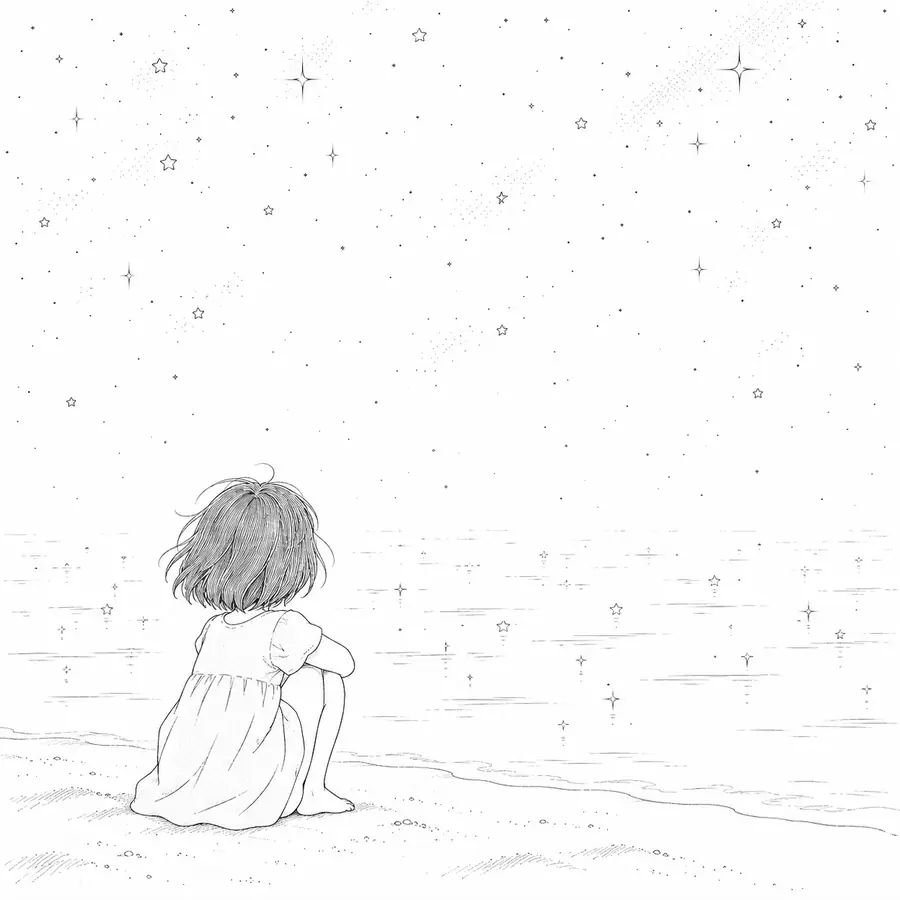
A poem: «hosi to nami»
Stars and waves.
Notes on the poem
- Line 1. to after a whole clause: "… and …". The two halves are the same shape, as the waves are.
- Lines 2–3. The poem turns on one word changed: sora becomes umi, and sizu (still) becomes odo (dances). A root has no part of speech, so a quality and an action stand in the same slot.
- Lines 4–5. dore in the doer slot, then ka. The questions are left open.
- Line 6. nuna is "no-person", from the grid. To be no one is still to be something you can assert.
- Line 7. -nu and -ro on siru: "may (I) not know". The same ending that commands and proposes here wishes, because the subject is the speaker herself.
- Line 8. nagi is both greeting and farewell. At the end of a poem it is both at once.
Everything you now know
Sounds. Five vowels a i u e o; consonants k g s z t d n h b p m y r w; the beat is (C)V or closing n: 67 beats of the kana table, plus n. The first beat of every root is high, also inside a compound, and so is the first beat of a pronoun, a grid word, a number or a name; endings and particles are low. Each high beat is a little lower than the last, and after a pause the voice starts again from the top. From one high beat to the next there is one root with its endings and particles. Nothing ever changes shape.
Words. Roots carry meaning and have two to four beats. Particles and endings have one beat. The digits are one beat but carry meaning; pronouns and grid words are longer but belong to the grammar. A root has no part of speech: last it is asserted, before a particle it is named, before another word it describes. A named action is the act or what it makes (uta, singing or a song); asserted last, it is the act, so a product is asserted with mono: kore wa uta mono. Compounds fuse describer + head, head last.
The sentence.
(phrase + particle)\* + predicate + (mood particle)
The predicate is last. There is no "to be". Anything obvious is left out. A phrase belongs to the nearest predicate after it; a topic (wa) and a phrase followed by a pause (a comma) belong to the last.
The particles — one meaning each, on a word or on a clause.
| with a word | after a clause | |
|---|---|---|
| wa | as for (topic) | as for …ing |
| ga | doer | that … (subject) |
| o | thing affected | that … (object) |
| ni | at | when |
| e | to | in order to |
| yu | from; than; by (agent) | because |
| ma | until, as far as | until |
| de | with, by means of | by …ing |
| to | and, with | … and … |
| no | of | relative clause |
| mo | also, even | although |
| ho | like, as | as, the way |
| ba | given | if |
| ka | or; question | whether |
| ne | …, right? | |
| sa | …, you know! |
ga and o drop before wa and mo; other particles stay.
The endings — on the last word, always in this order.
-ra plural · -se make · -re be done · -nu not · -te ongoing / -ri done-and-standing · -ta past / -ru future · -ro let it be / -ke would be
and -me for ordinals: eleven in all. Example: tabesereta, was made to eat. -nu denies its whole clause: mina ga koinuta, not everyone came. -ke makes a condition unreal: siruta ba, koitake, had (I) known, (I) would have come.
Describing. A word before a word describes it; each word describes the next. ito very. no links anything looser — possessor, place, clause — and closes a group.
Chains. Main verb first, helper last, endings on the helper: tabe horinuta, didn't want to eat. Helpers: hori eru beki yuru hazime owa tuzu tamesi sugi yasu muzu rasi.
Place and time. Position nouns with no … ni: ue sita naka soto mae ato yoko aida. Time words need a particle at the start of a sentence. Hours and months are ordinals: mime toki, hume tuki.
The grid. ko- this, so- that, do- which?, a- some, mi- every, nu- no × -re thing, -no which, -na person, -ko place, -ki time, -yo manner, -ho amount. do- + mo: any. Grid words and pronouns take only -ra and -nu. Connectors: sore + particle.
Numbers. ze hi hu mi yo i mu na ya ko; so momo sen yoro; digits multiply powers, groups in order: misen humomo yoso ko, 3249. A number never stands alone before a particle; it describes mono: hi mono o age, give one.
Comparing. yu than, ho as, nao more, sai most; ranges with no naka ni.
Free words. nagi hai iya arigato gomen dozo nega tabun, alone or before a comma.
That is the language. Everything else is in the dictionary.
Vocabulary
| word | meaning |
|---|---|
| mura | village |
| hama | beach, shore |
| nami | wave |
| iro | colour |
| oto | sound |
| mido | green |
| mabu | bright |
| ide | go out, emerge |
| suwa | sit |
| nozo | watch, gaze at |
| emi | smile |
| odo | dance |
| ten | heaven |
Exercises
- Translate into English: Mio wa yoru no umi ga dono iro ka o sirunuta.
- Translate into English: umi ni mo hosira ga aru.
- Translate into English: haha wa «soto e ikunuro» o iuta.
- Translate into Sumikoto: Mio quietly left the house.
- Translate into Sumikoto: The sea seemed black.
- Translate into Sumikoto: Mio went to the beach every night.
- Fill the particles: sora __ wa tuki __ hosi __ arunuta.
- Fill the particle: sono natu no owa __, Mio wa hama e ikuta.
- Build a sentence: rewrite line 15 of the story with yu instead of ho, so that the sea is brighter than a sky of stars.
- Write two lines of your own in the shape of the poem's lines 2–3: same frame, one noun and one predicate changed.
Answer key
- Mio didn't know what colour the night sea was.
- There are stars in the sea too.
- Mother said, "Don't go outside."
4.
5.
6.
7. ni, mo, mo
8. ma
9.
10. For example:
Texts
Seven well-known texts and a handful of one-liners. Tap a sentence to see how it is built. The translations keep to the grammar exactly as written; nothing here needs a rule the textbook does not teach.
One-liners
A language shows its character in short sentences. Each of these uses one idea from the grammar.
The old pond
Matsuo Bashō, 1686. The original is 5-7-5 beats, and so is the translation. sa, the particle of emphasis, stands where Bashō's cutting-word ya stands.
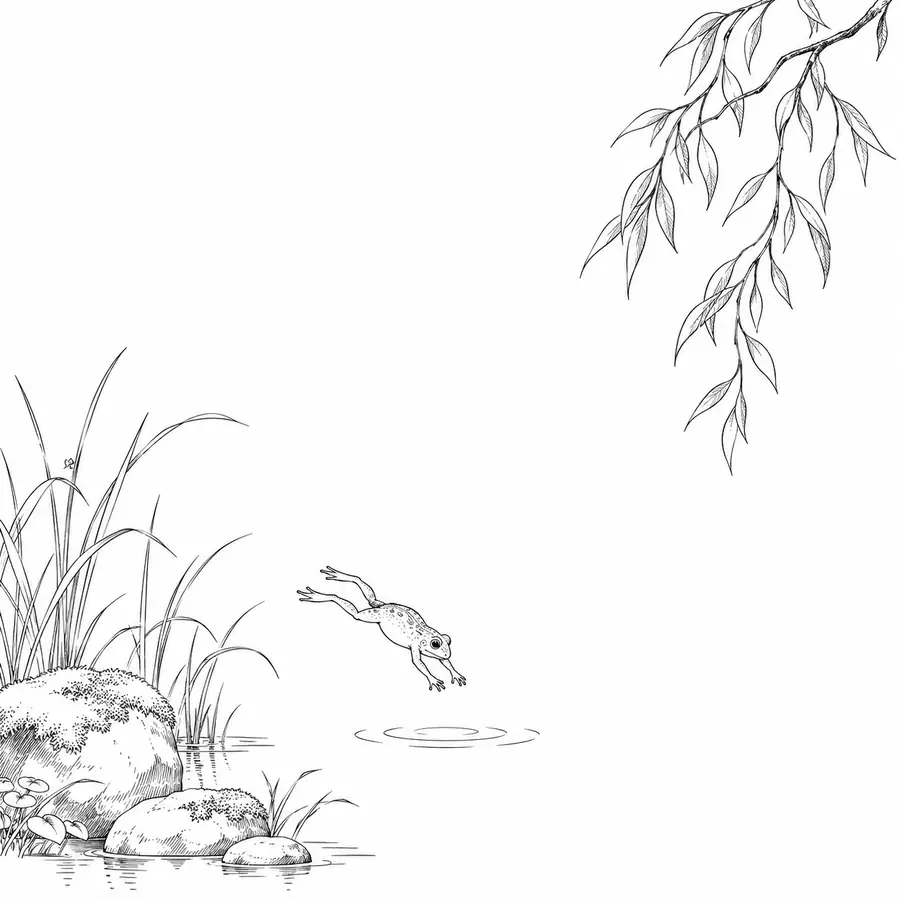
A second haiku by Bashō, written at the site of a battlefield in 1689, again 5-7-5.
In the beginning
Genesis 1:1–5.
Universal Declaration of Human Rights, Article 1
The Tower of Babel
Genesis 11:1–9, the text most often used to compare constructed languages.
The North Wind and the Sun
Aesop's fable, the passage phoneticians use to illustrate the sound of a language.
The Way
Laozi, Daodejing, chapter 1, opening lines.
To be, or not to be
Hamlet, act 3, scene 1.
Design notes
Sumikoto was designed in one long sitting by an AI, Claude, to a brief written by a person: a language as beautiful as Japanese to write and to speak, as regular and logical as Esperanto or more, incredibly expressive and pleasant to use and hear, almost mathematical without feeling like Lojban, with a simple and efficient grammar. This page explains the reasoning that led from that brief to the language, places the result among natural and constructed languages, and lists what was given up.
Three cautions before starting. First, the account of the design is partly a reconstruction: it was written after the language existed, and any designer's story of their own choices is tidier than the process was. Second, the comparisons with other languages were checked, in a later revision of this page, against the reference works listed under Sources at the end; where a point could not be checked, the text says so. Third, nobody speaks Sumikoto yet, so every claim below about how it sounds or how easy it is remains a claim about a design, not a finding about speakers.
Technical terms are explained in passing the first time they appear. Sumikoto words are shown in the script you have chosen; words from other languages are in italics.
Revision after review
November 2026. An outside review of the first version raised nine criticisms, most of them already listed by this page under Open problems. The language was revised to answer them, and this page was updated to match. In brief:
- Melody. The rule is now complete: every root starts on a high beat, also as the second half of a compound, and so do pronouns, correlatives, numbers and names; endings and particles are low; each high beat inside a phrase is a little lower than the last (downstep), and the voice resets after a pause. From one high beat to the next there is exactly one root with its endings and particles, and the checker now tests the lexicon against that. The old phrase "one small falling wave" is gone.
- The pause is grammar. A phrase belongs to the nearest predicate after it, but a topic and any phrase followed by a pause (a comma) belong to the last one. The checker now runs a partial syntax pass over every example.
- The unreal. A new ending, -ke, in the same slot as -ro, marks what would be or would have been: siruta ba, koitake "had I known, I would have come". There are now eleven endings.
- Confusable roots. Twenty roots were renamed, among them hona nose (now kobana), kira hate (now kirai) and tame try (now tamesi), and the checker refuses helper roots that differ by one vowel. The sound space remains dense.
- What a root asserts. The grammar now says what the n/a/v mark is (the kind of idea) and how a named action reads (the act, and by extension its product); a product is asserted with mono or the passive.
- Scope. -nu denies its whole clause, and to binds tighter than no.
- Melody contradiction. The grammar described a single falling wave per phrase while giving every root a high beat; the downstep rule above replaces the first description.
- Sounds and script. The beats di du wi we wo were removed (68 beats with the closing n, not 73). Sumimozi is no longer called featural; size alone marks grammar, and the red only repeats it. The glyph shapes were not redesigned.
- Correlatives and numbers. The amount column is now -ho (doho how much), so place, time and amount are -ko, -ki, -ho. Pronouns and correlatives take only -ra and -nu. A number never stands alone before a particle; it describes mono.
What these changes do not fix is set out item by item under What was given up, and open problems at the end of the page.
Reading the brief
The wishes in the brief pull in different directions, so the first step was to decide what each one is really asking for.
What is beautiful in Japanese. Open syllables of nearly equal length, so speech has an even pulse. Small words that come after what they mark, so a sentence is a row of labelled pieces. The statement held back until the end. The freedom to leave out whatever is obvious. And a script, kana, whose signs match the beats of speech one for one.
What is irregular in Japanese. Verb classes and the sound changes at their seams (kaku "write" but kaite "writing"), counters that depend on the shape of the thing counted (-hon for long objects, -mai for flat ones), politeness built into verb forms (taberu, tabemasu, meshiagaru, all "eat"), several readings for one character, and, in the standard Tokyo variety, a pitch accent that must be learned word by word. None of these is what people usually mean when they call the language beautiful, so all of them could go.
What Esperanto gets right. A short grammar, published in the Fundamento de Esperanto (1905), with very few exceptions, and words that build other words (lerni "learn", lernejo "school", lernanto "student"). Its table of correlatives, where what, that, everything, nothing are cells of a grid, is the most admired single piece of design in the planned-language tradition, though it has its critics (see below). Even Esperanto is not quite exception-free in practice: speakers argued for decades over the meaning of its passive participles, the so-called ata/ita dispute.
What Lojban gets right, and why the brief wanted to avoid its feel. Lojban has a formal grammar under which a sentence has exactly one syntactic parse, and its words are built so that a stream of speech can be cut into words in only one way. Those are the mathematical properties worth having. The brief's wish not to "feel like Lojban" was read as a complaint about the surface: a Lojban speaker manages numbered argument places (citka "eat" has an eater, x1, and a food, x2), small closing words that end a construction (ku, kei, vau), and a vocabulary built for logic rather than for sound. The aim here was to keep the properties and hide the machinery.
Six decisions, in the order they were made
1. The sounds are the kana table. Five vowels, fourteen consonants, and 68 beats (67 consonant-vowel or vowel beats, plus the closing n): the kana table as it is spoken today. The first version also kept di du wi we wo, 73 beats in all; the revision removed them, because a modern Japanese speaker hears them as zi zu i e o. This was decided first because everything else rests on it: it gives the even pulse, it makes hiragana an exact spelling with no rules, and it keeps every word pronounceable by speakers of most languages.
2. Length and pitch tell you the kind of word. Every particle, every ending and every digit is one beat. Every root that carries meaning has two to four. This is where much of the mathematics went: a listener can hear the skeleton of a sentence, phrase, marker, phrase, marker, statement, before understanding a single word. Length alone is not a complete classification, and it should not be stated as one: the digits (hi one, mi three) are one-beat words that do carry meaning, and the pronouns, the correlatives and the large numbers (ware, kore, momo) are grammar words of two beats. Since the revision, pitch does the sorting that length cannot: roots, digits, pronouns, correlatives and names all start on a high beat, and only particles and endings are low. In Sumimozi the same fact is drawn by size: roots large, particles and endings small, digits full size.
3. One rule of syntax, used at every size. A particle closes whatever stands before it, whether that is a word, a phrase or a whole sentence, and it means the same thing each time.
That single choice removes subordinating conjunctions, relative pronouns, infinitives and the difference between a case ending and a preposition. Together with two ordering rules (the predicate comes last; a describing word comes before what it describes) and one attachment rule (a phrase belongs to the nearest predicate after it, unless it is a topic or is followed by a pause, in which case it belongs to the last), the sixteen particles are the whole syntax.
4. Roots have no part of speech. A root names an idea, and its place in the sentence gives it a job: asserted at the end, describing before another word, named before a particle. This removes the verb to be and all the machinery that turns adjectives into adverbs and verbs into nouns. How far this really abolishes word classes is discussed below under Flexible roots.
5. Eleven endings, ten of them in one fixed order, all optional. Nothing is marked by obligation. Tense is said when it matters and left out when it does not, as plural is. Because the order never changes, a stack of endings can be read like the digits of a number. (The first version had ten; the revision added the unreal -ke. The eleventh, ordinal -me, goes only on numbers.)
6. Small closed systems are grids. The correlatives are six stems by seven endings, and every cell exists. The numbers are ten digits and four powers. The pronouns use the same ending as the correlatives. A learner fills these in once and never meets a gap.
Where the small words come from
Most of the grammar words are real Japanese morphemes, modern or classical, made regular. They were chosen so that the language sounds like a relative of Japanese and not like a code. The table states the source of each and, just as important, where the Sumikoto meaning differs, because a learner who knows Japanese will meet these as false friends.
| Sumikoto | source | what changed |
|---|---|---|
| wa ga o ni e to no mo ka | the everyday Japanese particles | Japanese writes three of them with historical kana (は, を, へ); Sumikoto kana writes them as they sound (わ, お, え) |
| de, ma | Japanese de "with, by, at", made "until" (clipped) | none in meaning |
| yu | Old Japanese ablative "from", attested as yu, yo, yuri and yori; only yori survived into Early Middle Japanese, where it already meant both "from" and "than" | used for source, cause, agent and comparison |
| ho | probably hodo "extent, as much as" (a reconstruction; the original notes do not say) | means "like, as" |
| ba | Japanese conditional -ba | in Japanese an ending on the verb, here a free particle |
| ne, sa | sentence-final particles of colloquial Japanese | none |
| -ta | Japanese past -ta | none |
| -te | the -te of Japanese -te iru | Japanese -te iru is progressive or resultative depending on the verb; -te is only progressive |
| -ru | Japanese non-past -ru | false friend: in Sumikoto it is the future |
| -ro | Japanese imperative of one verb class (tabero "eat!") | extended to wishes and proposals in every person |
| -ke | added in the revision; its source is not recorded. Classical Japanese -kemu, which conjectures about the past, is one possible model (a guess) | marks the unreal, past or present, in the main clause of a condition |
| -se, -re | Japanese causative -(s)ase- and passive -(r)are-, cut to one beat | none in meaning |
| -nu | Classical Japanese -nu, the attributive form of the negative auxiliary -zu (shiranu hito "a person who does not know") | the only negative; note that Classical Japanese also has a homophonous perfective -nu |
| -ri | Classical Japanese -ri, "the result continues", as in sakeri "has bloomed, is in bloom" | in Classical Japanese it attaches only to certain verb classes; here to every root |
| -ra, -me | Japanese -ra (karera "they") and ordinal -me (futatsume "the second") | none |
| hi hu mi yo i mu na ya ko | Japanese native numerals hitotsu, futatsu, mittsu, yottsu, itsutsu, muttsu, nanatsu, yattsu, kokonotsu, cut to their first beat | none |
| so, momo, sen, yoro | Old Japanese -so "ten" (as in misoji "thirty"), momo "hundred", Sino-Japanese sen "thousand", yorozu "ten thousand, myriad" | yoro is a million, not ten thousand |
| ware nare kare onore | Classical Japanese ware "I", nare "you", kare "that one, he", onore "oneself" | none |
| ko- so- do- | Japanese ko-so-a-do demonstratives | Japanese has three degrees of distance; Sumikoto has two |
| a- | Japanese distal a- "that over there" | false friend: in Sumikoto it means "some" |
Where the language sits
Linguists describe a language's overall shape by a set of independent properties, many of them mapped for hundreds of languages in the World Atlas of Language Structures (WALS). The table places Sumikoto beside the three languages the brief names.
| property | Sumikoto | Japanese | Esperanto | Toki Pona |
|---|---|---|---|---|
| basic order | subject, object, verb; phrases may move, the predicate stays last | subject, object, verb; verb last | subject, verb, object preferred, freely varied | subject, verb, object |
| small words that mark roles | after the phrase (postpositions) | after (postpositions) | before (prepositions) | before (li, e, prepositions) |
| describing word | before the head | before | adjective usually before, may follow | after the head |
| relative clause | before the noun, linked by no | before the noun, no linker | after the noun, with kiu | no dedicated construction |
| where roles are marked | on the dependent | on the dependent | accusative -n on the dependent; no verb agreement | by particles |
| leaving out the obvious | anything | anything | the subject is normally expressed | the subject is normally expressed |
| verb "to be" | none | da, desu, often dropped in speech | esti | none |
| tense | optional | obligatory: past or non-past | obligatory | none |
| plural | optional -ra | mostly unmarked | obligatory -j | none |
| agreement | none | none | adjectives agree in number and case | none |
| word classes | flexible roots | nouns, verbs, two adjective classes | shown by the endings -o -a -e -i | flexible |
Head-final. The head of a phrase is the word that decides what kind of phrase it is: the noun in a big mountain, the verb in eat fish. Sumikoto puts the head last at every level: the predicate ends the sentence, the particle ends its phrase, the noun ends its noun phrase, the helper root ends a verb chain, and the second root of a compound is its head. Japanese and Korean are the best-known languages of this rigidly head-final type. Greenberg (1963) and, with a much larger sample, Dryer (1992) showed which properties tend to go with object-before-verb order: postpositions, possessor before noun, question particles at the end of the sentence. Sumikoto has all of them. Dryer also showed that adjective-before-noun order does not reliably go with the others; Sumikoto chooses it for consistency, not because languages require it.
Dependent-marking. Johanna Nichols (1986) distinguished languages that mark a grammatical relation on the dependent word (a case ending on the noun) from those that mark it on the head (agreement on the verb, a possessive ending on the possessed noun). Sumikoto is purely dependent-marking: every role is a particle after the dependent phrase, and the predicate never agrees with anything. Japanese is the same. Ainu, the other indigenous language of Japan, makes an instructive contrast: it is also verb-final, but it marks the persons involved by prefixes on the verb.
Topic-prominent as well as subject-prominent. Li and Thompson (1976) classified languages by whether the basic sentence is built on a subject (the participant the verb is predicated of, as in English) or on a topic (what the sentence is about, as in Mandarin). Japanese and Korean have both, each with its own marker, and so does Sumikoto: wa for the topic, ga for the subject. See Topic and subject below.
Agglutinating, with low synthesis. A language is agglutinating when its words are built from pieces that each keep one form and one meaning, and fusional when one piece carries several meanings at once, as Latin -ibus carries both "plural" and "dative or ablative". Sumikoto's endings are an extreme case of agglutination: one form each, no variants, no fusion. But agglutination is a different measure from synthesis, the average number of meaningful pieces per word (Greenberg 1960). Because every ending is optional, Sumikoto text is in practice close to isolating. Counted over the texts and the twelve lessons of this site (about 4 400 words), it has 1.13 meaningful pieces per word if particles are counted as words, or 1.69 if particles are counted as suffixes of the preceding word, as Japanese and Korean grammars often treat them. (Figures often quoted for comparison, around 1.06 for Vietnamese and 1.68 for English, are attributed to Greenberg in secondary sources; they could not be checked against his paper.)
Radical pro-drop. Many languages may leave out a subject pronoun because the verb's agreement shows who it was (Spanish comí "I ate"). Japanese, Korean and Chinese go further and may leave out any argument, with no agreement at all to recover it from; Neeleman and Szendrői (2007) call this radical pro-drop. Sumikoto is of this second kind: uo o tabeta. can be "I ate the fish", "they ate the fish" or "someone ate the fish", and only the context decides.
Zero copula. Many languages say "Ken (is) a student" with no verb "be", always or in the present tense (WALS chapter 120, by Leon Stassen). Sumikoto never has one, and its tense endings go directly on the nominal predicate: kare wa narahitota. "She was a student". Turkish is the closest natural model: öğrenci-ydi "(s)he was a student" puts the past directly on the noun. Japanese, by contrast, does have a copula, da or desu, although casual speech often drops it.
Mora timing. A mora is a unit of length: in Japanese, ho-n "book" has two and To-o-kyo-o four. Japanese is often described as mora-timed, meaning that each mora takes roughly the same time. Experimental work has not found literal equal durations (the review by Warner and Arai 2001 concludes that the evidence for strict compensation is not persuasive), but the mora is real for speakers: poetry counts it, and kana spells it. Sumikoto's "every beat takes the same time" should be read in the same way, as an ideal that guides pronunciation, not a measurement.
Flexible roots
In most languages, words fall into classes with different jobs: nouns refer, verbs predicate, adjectives modify. Kees Hengeveld (1992; Hengeveld, Rijkhoff and Siewierska 2004) classifies languages by how many of four jobs one class of words can do: head of a predicate, head of a referring phrase, modifier of a referring phrase, and modifier of a predicate. English is differentiated (a class for each job). Flexible languages let one class do several jobs; Tongan, Samoan and Turkish are among the examples discussed in this literature, though each case is debated. Sumikoto is designed as the extreme flexible case: one class, the root, does all four jobs, and position alone decides which.
The debate about natural languages is a useful test for the design. Mundari, a Munda language of India, was long cited, following a grammar of 1903, as a language without nouns and verbs. Evans and Osada (2005) argued that it does have them, and proposed three tests that a claim of "no word classes" must pass. Bidirectionality: words of every class must be usable in every position. Exhaustiveness: this must hold for the whole vocabulary, not a selection. Compositionality: the meaning in each position must be predictable from the word's meaning and the position, not learned word by word. Sumikoto passes the first two by construction. It only partly passes the third. What a root asserts in last position depends on a class the dictionary records: hito. is "(it) is a person", ao. "(it) is blue", uta. "(he) sings". And what a named action means is not fully predictable: uta before a particle can be "a song" (the result) or "singing" (the event). Sumikoto, in other words, has semantic classes, just as the natural languages in this debate turned out to have. The first version kept them covert; the revised grammar states them. The n/a/v mark says what kind of idea a root is, a named action is the act and by extension its product, an asserted action is always the act, and a product is asserted with mono or the passive:
That makes the classes overt and the readings predictable at the end of a sentence. Before a particle, choosing between the act and the product is still left to context.
Classical Chinese is the other classic case. A word could change its function with no change of form, and grammarians call this huóyòng, "living use". The best-known example is Confucius's answer on government in the Analects (12.11), jūn jūn, chén chén, fù fù, zǐ zǐ, "let the ruler be a ruler, the minister a minister, the father a father, the son a son", in which each noun is followed by itself used as a verb. Sumikoto can say the same without any change of form:
Toki Pona follows the same principle as Sumikoto (moku is "food" or "eat" depending on position), and it is the conlang closest to Sumikoto in this respect.
Sounds
Inventory and syllables
| language | consonants | vowels | syllable shape | notes |
|---|---|---|---|---|
| Sumikoto | 14 | 5 short | (C)V, and a closing n | 68 beats; no long vowels inside a root, no doubled consonants, no kya-type beats |
| Japanese (Tokyo) | about 15, depending on the analysis, plus a moraic nasal and a moraic stop | 5, short and long | (C)(y)V, closed only by the moraic nasal or by the first half of a doubled consonant | well over a hundred distinct morae |
| Hawaiian | 8 (p k ʔ h m n l w) | 5, short and long | (C)V | among the smallest inventories of any language |
| Toki Pona | 9 (p t k s m n l j w) | 5 | (C)V(n) | ji, ti, wo, wu are not allowed |
| Esperanto | 22 and the semivowel ŭ | 5 | clusters of up to three consonants at the start (str-) and two at the end | European-style syllables |
Sumikoto's sound is therefore a simplified Japanese: the same consonants and vowels, but none of the long vowels (obasan "aunt" against obaasan "grandmother"), doubled consonants (kite "coming" against kitte "stamp") or palatal beats (kya, shu, cho). It is larger than Hawaiian or Toki Pona, and much simpler in syllable shape than Esperanto.
A small inventory has two costs, and Sumikoto pays both. Words are longer, because there are fewer distinct short words to go round; this is why every root has at least two beats. And words sit close to one another in sound. Of the 717 two-beat roots in the dictionary, 713 differ from another root by a single consonant or vowel, with about nine such neighbours each on average: hana flower, hama beach and hane jump; kire beautiful and kiri fog. In noise, or from a learner, one slip gives another real word. Lojban's designers screened new roots against close resemblance to existing ones. Sumikoto's revision did something narrower. It renamed twenty roots: most because a neighbour was too close or too likely to be confused (hona nose, next to hana flower, became kobana; kira hate, next to kire beautiful, became kirai), a few because the new ending and the new spoken check made them readable as a shorter word (namake lazy could be nama + -ke, akira obvious could be aki "sometime" + -ra). And the checker now refuses two helper roots that differ by one vowel, because helpers stand in the same position after a verb. It does not screen ordinary roots for resemblance, and with 67 beats it could not remove the neighbours without lengthening most words.
The first version had 73 beats, and seven of them occurred in no root at all: di, du, pu, pe, wi, we, wo. Five of these, di du wi we wo, are exactly the beats a modern Japanese speaker would merge with zi, zu, i, e, o, and the revision removed them from the inventory. Of the 68 that remain, pu and pe still occur in no entry, so the working inventory is 66 beats.
The melody
The grammar's rule is that the first beat of every root is high and its endings and particles are low. It helps to compare it with the real pitch accent of Tokyo Japanese. There, a word may have a fall after any one of its morae, or no fall at all, and where the fall comes must be learned for each word: háshi (high-low) is "chopsticks", hashí (low-high, then a low particle) is "bridge", and hashi (low-high, and the particle stays high) is "edge". A word with its fall after the first mora is called atamadaka, "head-high". Sumikoto's rule, in these terms, is that every root is atamadaka.
That turns a lexical accent, which distinguishes words, into a demarcative one, which marks where words begin, a function Trubetzkoy described in the 1930s. Finnish, Hungarian and Czech put a fixed stress on the first syllable of every word for the same effect, and Esperanto's fixed stress on the next-to-last syllable signals, more loosely, that a word is about to end.
The first version of the rule left three things open, and the revision settled each of them. The digits, the pronouns, the correlatives and names now carry the high beat like roots; this matters for hearing word boundaries (see the next section). The second root of a compound starts high again. And a phrase with several roots, such as ito oki yama "a very big mountain", has several high beats, so the first grammar's description of each phrase as "one small falling wave" contradicted its own rule. Japanese handles the same situation by downstep: each accent lowers the pitch range for what follows, so a phrase steps down. Sumikoto has now adopted it explicitly: each high beat inside a phrase is a little lower than the last, and after a pause the voice starts again from the top. The falling-wave description was dropped.
Two consequences should be stated plainly. A compound and the same two roots said loosely now have the same melody, by design: narahito "student" and nara hito "a learning person" both have two high beats, and only the dictionary makes the first a fixed word. And because downstep lowers each high beat, the contrasts are relative. Where two high beats touch, as in hi tosi "one year", the second is only a step below the first; in hitosi "equal" the second beat falls to low. The difference between a step and a fall is all the listener has. Whether that is easy to produce and to hear at speed is a question for speakers, which nobody has asked yet.
On beauty
Whether a language is beautiful is not something linguistics can settle, and claims about euphony deserve caution. What can be said is narrower. Sumikoto has the properties listeners often name when they call Japanese, Italian or Hawaiian musical: open syllables, no consonant clusters, five clear vowels, and an even rhythm. To a listener who knows Japanese it will sound like Japanese. It may also sound like Japanese spoken with odd words, because many roots are clipped or altered Japanese words (kire "beautiful" from kirei, which in Japanese sounds like kire "a cut, a piece"). Whether that is charming or distracting can only be found out by asking speakers.
Hearing where words end
What other languages do
A language has self-segregating morphology when a stream of speech, with no pauses, can be cut into words in only one way. Natural languages do not have it: English a nice man and an iceman sound alike, and listeners rely on context. Constructed languages have tried several ways to get it.
- Loglan (James Cooke Brown, first described in 1960) made the unique cutting of speech into words an explicit design goal, and Lojban (1987 onwards) inherited it.
- Lojban has three word classes recognisable by shape alone: structure words (cmavo), short and without consonant clusters; content words (brivla), which contain a consonant cluster near the start and are stressed on the next-to-last syllable; and names (cmene), which end in a consonant and are followed by a pause. The reference grammar states that a stream of Lojban sounds can be "uniquely broken up into its component words", while admitting that the detailed algorithm "has not yet been fully debugged". The guarantee depends on stress and pauses being produced correctly.
- Solresol (François Sudre, from 1827), built from the seven note names, tied word length to word kind: the one-syllable words are the commonest grammatical words (do "no", re "and", mi "or", in Gajewski's grammar), and reversing a word's syllables reverses its meaning (misol "good", solmi "evil"). It did not attempt a segmentation guarantee.
- Toki Pona and Esperanto do not attempt one. Toki Pona's structure comes from its particles (li before the predicate, e before the object, la after a context phrase, pi to regroup modifiers). Esperanto joins roots and affixes without boundary signals, and relies on spaces in writing and its fixed stress in speech.
What Sumikoto guarantees, exactly
Sumikoto's guarantee has two parts, and they should be kept apart.
In writing, words are separated by spaces, and every written word has exactly one analysis into a root and endings. This is a property of the dictionary, checked by a program (tools/sk.py) over all 2 413 entries. The program verifies that no entry equals another entry plus a legal string of endings (so tabeta can only be tabe + -ta), that no entry equals another entry plus a particle, that no root looks like two roots joined, and that no entry reads as a number word. Because the ten stacking endings come in a fixed order and their syllables are all different from the particles, the run of short beats after a root can always be divided in one way.
In speech, there are no spaces, and the guarantee rests on the melody: each high beat starts a root, a digit, a pronoun, a correlative or a name, and the low beats after it are endings and then particles. So from one high beat to the next there is exactly one such word with its endings and particles. Since the revision the program checks this too: no root or grammar word may sound like a shorter one followed by legal endings and a legal run of particles. (That check is what caught akira "obvious", which sounded like aki "sometime" with the plural -ra, and tokorode "by the way", which sounded like toko "place" + -ro + de.) If the melody is produced as the grammar says, the stream divides in one way.
What it does not guarantee
- The guarantee depends on pitch. Beginnings of words are now covered by the melody, not by the shapes of words. In the dictionary, 63 entries begin with a digit followed by another entry, and 52 with a particle followed by one: hitosi "equal" against hi tosi "one year", hikari "light" against hi kari "one hunt". Because a digit now carries its own high beat, hi tosi has two high beats and hitosi one; and a particle is low where a root begins high, so otoko "man" does not sound like o followed by toko. The pairs differ. But they differ only in pitch, and only as much as a downstep differs from a fall. A speaker who flattens the melody, or a listener in noise, loses the distinction, just as Lojban loses its guarantee when stress and pauses are not produced.
- One case is excluded by rule, not by sound. A digit is one high beat and a particle one low beat, so a digit standing alone before a particle would sound exactly like a two-beat root: mi o "three (as object)" would be the name Mio. The grammar forbids it instead (a number describes a word, and with nothing else to describe it describes mono: mi mono o), and the syntax pass reports a bare number before a particle. A speaker who breaks the rule produces a real ambiguity.
- Compounds and loose pairs sound alike, by design. narahito "student" and nara hito "a learning person" differ only by a space in writing. One compound, hihito "individual", is a digit joined to a root, and is indistinguishable from hi hito "one person". The revised grammar accepts this: a compound is only a pair the dictionary has fixed.
- Syntax is only partly checked. The program checks that every word in every example is a real word with legal endings, and since the revision it also runs a syntax pass (sk.py parse prints it): it attaches each phrase by the grammar's rule and reports a predicate that receives two ga or two o phrases, a sentence that ends on a role particle, and a bare number before a particle. It cannot tell when a bare noun is the predicate of an inner clause. In ware ga tori ba, tobike "if I were a bird, I would fly", it attaches ware ga to tobike rather than to tori, and so it would miss a real error of the same shape. An earlier version of this page said the program parsed every example sentence, which overstated it; the pass now catches common slips, not all of them.
And the grammar, although it is regular, still has places where a sentence can be read in more than one way. These are the main ones.
- Grouping of describing words. ito oki yama is "a very big mountain"; in longer strings it can be unclear which word a describer attaches to. The grammar admits this and offers no to close a group: ito oki no yama.
- The reach of to "and". The first version did not say how much a relative clause before two nouns joined by to covers: in hito no kodora ga tateta no mati to yagura "the city and tower that the children of men built", it could describe both nouns or only the first. The revised grammar settles that case: to binds tighter than no, so the clause describes both, and to describe only one, that one is said last. When two clauses joined by to are followed by another particle, how much the particle covers is still not marked.
- A one-word clause looks like a noun. ame mo is "rain too" or "although it rains"; an ending settles it.
- The role of a relativised noun is not marked, and with arguments freely dropped, miyuta no hito is "the person who saw (someone)" or "the person (someone) saw". Japanese mita hito has exactly the same ambiguity.
- Scope of quantifiers. The first version did not say how mina "everyone" and the negative ending interact: mina ga koinuta could be "no one came" or "not everyone came". The revision gives -nu the whole clause, so it means "not everyone came", and "no one came" is nuna ga koita. How two quantifiers in one clause interact ("everyone read some book": one book, or one each?) is still not defined. Lojban settles this kind of question by word order and by an explicit prefix of quantifiers (the prenex); this is one of the places where its "coldness" buys real precision.
- One particle, several senses. yu is source, cause, agent and than, so kare yu tabereta is "was eaten by him" or "was eaten because of him".
Finally, one rule is deterministic but costly. A phrase belongs to the nearest predicate after it, and an inner clause has a predicate. So any phrase placed before an inner clause, with no pause after it, is captured by it:
The first sentence is not ambiguous, which is the point of the rule, but it does not mean what an English or Japanese speaker would expect. Japanese allows the first order and leaves the attachment to sense. The first version of Sumikoto offered only one remedy, saying the inner clause first and in one piece. The revision adds a second: a phrase followed by a pause belongs to the last predicate, like a topic. So the expected order works if the speaker pauses:
This makes the comma, and the pause it writes, part of the grammar. A few translations on this site had used a comma as if it had some such power while the grammar gave it none; those the new rule does not cover were rewritten. The cost moves rather than disappears: a speaker must pause where the grammar needs it, and a pause taken only for breath before an inner clause will send a phrase to the wrong predicate. This is still the most demanding habit the language requires.
One particle rule at every scale
Sumikoto uses the same particle after a noun and after a clause, with the same meaning. Natural languages do this often, but rarely so uniformly, and the reasons are instructive.
Japanese comes close in places. Kara is "from" after a noun (uchi kara "from home") and "because" after a clause (ame ga futta kara "because it rained"); made "until" works with both. Elsewhere the meanings have drifted apart. After a noun to is "and, with"; after a clause it is a conditional, "when, whenever, if" (haru ni naru to, hana ga saku "when spring comes, the flowers bloom"). After a noun ga marks the subject; after a clause it means "but". And to make a clause into an object, Japanese normally adds a nominaliser, no or koto, before the particle (kare ga kita koto o shitta "I learned that he had come"). Sumikoto drops the nominaliser and fixes the meanings.
The meanings Sumikoto chose are the ones languages tend to develop. Work on grammaticalisation, the process by which words turn into grammar, has found the same paths in unrelated languages: a word for "to, toward" becomes a marker of purpose (Haspelmath 1989), "from" becomes "because", "at" becomes "when", and an additive "also, even" becomes "although" (as in Japanese -te mo "even if"). Using "from" for comparison, as yu does, is a common type in the world's languages (WALS chapter 121, Stassen): Japanese yori, Turkish -dAn. So when Sumikoto says ame yu "from raining" for "because it rains", a learner meets a pattern many languages share.
Other languages build complex sentences the same way, by treating a clause as a noun and adding a case marker. Turkish does it with a nominalising suffix and an ordinary case ending: gel-diğ-i-ni bil-iyor-um "I know that he came" (come-NOMINALISER-his-OBJECT know-PRESENT-I). Quechua does the same; in Santiago del Estero Quechua, miku-na-ychis-paq "so that we eat" is a nominalised verb with the case ending -paq "for" (Juanatey 2021). Sumikoto is simpler than both: the clause needs no nominaliser, because a root already has no part of speech.
Relative clauses with one linker. Sumikoto's no links a possessor, a longer describing phrase or a whole clause to the noun after it. This is not the Japanese pattern (Japanese says watashi ga mita hito "the person I saw" with nothing between clause and noun), but it is exactly the Mandarin one: de links all three, as in wǒ de māo "my cat" and wǒ kànjiàn de rén "the person I saw".
Where natural languages are less uniform, and why. Three reasons stand out. Clauses carry different amounts of structure depending on their job: Minami Fujio's classification of Japanese subordinate clauses (1974) sorts them into types that allow progressively more inside them, from clauses with -nagara "while", which cannot even have their own subject, to clauses with kara "because" or kedo "but", which can carry nearly a full sentence. Grammaticalisation also lets meanings drift, as with Japanese clause-final ga "but". And frequent combinations fuse. Sumikoto freezes the system at the point before drift, which is easy to learn but means that some common meanings have to be built from phrases: "after doing" is no ato ni, "while" has no single particle.
Clause chaining. Japanese and Korean link a series of actions with a non-final verb form (Japanese -te, Korean -go), and many languages of New Guinea distinguish medial verbs, which only appear inside a chain, from the final verb. Sumikoto has no such form; it uses to "and" after a clause, or a comma. That keeps the grammar small, but long narrative sentences become strings of separate clauses.
Correlatives and other closed grids
Esperanto's table crosses five initial parts (ki- which, ti- that, i- some, ĉi- every, neni- no) with nine endings (-u person or individual, -o thing, -a kind, -es possessor, -e place, -am time, -el manner, -al reason, -om amount), giving 45 words such as kiam "when", tiam "then", neniam "never". Its strengths are obvious: 45 words learned as 14 pieces. Its known criticisms are three. The forms are not recognisable to speakers of any natural language. They differ from one another by single sounds (kiam, tiam, iam, ĉiam), which is fragile in noise. And the grid is foreign to European languages, which led to reform: Zamenhof's own reform proposal of 1894 would have replaced the table with Romance-like words, and Ido (1907) did replace it with more Latinate forms. Most Esperanto speakers rejected both changes, and Ido became a separate language.
Japanese ko-so-a-do is a natural grid. Four initial parts (ko- near the speaker, so- near the listener or just mentioned, a- far from both, do- which) combine with endings for thing (kore), determiner (kono), place (koko), kind (konna), manner (kō) and direction (kochira). It has gaps and irregular cells: the far place is asoko, not the expected ako, and "who", "what" and "when" (dare, nani, itsu) are outside the grid. Indefinites are made by adding -ka to a question word (dareka "someone"), and -mo gives "every" or, with a negative, "no" (daremo konakatta "no one came"). Building indefinites from question words is the most common strategy in the world's languages (Haspelmath 1997).
Sumikoto's grid is Esperanto's design in Japanese sounds: do- for Esperanto ki-, ko- and so- for ti-, a- for i-, mi- for ĉi-, nu- for neni-, with seven endings instead of nine (there are no cells for possessor and reason; "why" is dore yu, "from what"). It inherits Esperanto's fragility: koko, soko, doko, ako, miko, nuko differ only in their first beat. In the first version the place, time and amount columns also differed only in their last vowel (-ko, -ki, -ku), so that koko "here" and koku "this much" were one vowel apart. The revision moved the amount column to -ho (koho, doho "how much"), which matches the particle ho "like, as much as"; place and time, -ko and -ki, still differ by a vowel. The grid words also take only two endings now, -ra and -nu (soyonu "not so"); anything else leans on a root (koko ni aruro "be here!"). And the grid keeps a Japanese habit that overlaps with it: doko mo "anywhere at all" next to miko "everywhere".
Numbers form the other grid, and here Sumikoto is close to Japanese and Chinese: misen humomo yoso ko (3 249) is built exactly like Japanese san-zen ni-hyaku yon-jū kyū, "three thousand two hundred four ten nine". One difference matters: Japanese and Chinese group large numbers by ten thousands (man), while Sumikoto's powers are ten, a hundred, a thousand and a million, like European languages.
Tense, aspect and mood
Tense places an event in time (past, future). Aspect says how the event unfolds (ongoing, completed with a lasting result). Mood says how the speaker stands toward it (asserted, wished, commanded, or unreal). Sumikoto's endings cover these as follows.
| ending | standard term | Japanese | Esperanto | Turkish |
|---|---|---|---|---|
| -se | causative | -sase- | -ig- | -DIr- and variants |
| -re | passive | -rare- | esti + passive participle | -Il- |
| -nu | negation | -nai | the word ne | -mA- |
| -te | progressive | -te iru (with action verbs) | no dedicated form | -Iyor |
| -ri | resultative perfect | -te iru (with change-of-state verbs) | estas + -inta | partly -mIş |
| -ta | past | -ta | -is | -DI |
| -ru | future | none: the non-past covers it | -os | -(y)AcAk |
| -ro | volitive: command, proposal, wish | imperative -ro, volitional -yō | -u | imperative, -(y)AlIm "let us", -sIn "let him" |
| -ke | counterfactual (unreal) | no single form: constructions such as -tara … noni | -us | conditional -sA in the condition, -(I)rdI in the main clause |
The order follows a known tendency. Joan Bybee (1985) found that endings whose meaning affects the verb most directly stand closest to it: first those that change who takes part (causative, passive), then aspect, then tense, then mood. Sumikoto's order is that order, with negation between voice and aspect, where Japanese and Turkish also put it:
Japanese tabe-sase-rare-nakat-ta has the same pieces in the same order, and Turkish ye-dir-il-me-di "(he) was not fed" (eat-CAUSATIVE-PASSIVE-NEGATIVE-PAST) is the same construction.
Splitting what Japanese leaves to the verb. Japanese -te iru means "is doing" with verbs of activity (tabete iru "is eating") but "is in the state that results" with verbs of change (shinde iru "is dead"), a distinction Kindaichi Haruhiko described in 1950. Sumikoto gives each reading its own ending:
Optional tense. Japanese, Esperanto and Turkish all require a tense on a finite verb. Sumikoto does not; an unmarked predicate means "now, or whenever". Mandarin works this way (Lin 2006 analyses how Mandarin speakers locate events in time without tense), and so do Indonesian, which uses adverbs such as sudah "already" and akan "will" when needed, and Toki Pona.
One volitive for every person. -ro commands with "you", proposes with "we" and wishes with anything else (warera wa ikuro "let's go", ame ga owaro "may the rain end"). This is precisely Esperanto's -u: iru! "go!", ni iru "let us go", li venu "let him come".
The unreal, added in the revision. Esperanto has a conditional -us for things that are not or were not so: se mi scius, mi venus "if I knew (or had known), I would come (or have come)". Japanese expresses regret for an unreal past with constructions such as shitte itara, kita noni "if I had known, I would have come". The first version of Sumikoto had nothing comparable, so siruta ba, koita. was either "if I knew, I came" or "had I known, I would have come". The revision added -ke, in the mood slot with -ro, on the main predicate; the condition keeps its plain form.
Unlike Esperanto's -us, -ke combines with tense, so koike "would come" and koitake "would have come" are distinct. And where Esperanto puts -us in both clauses, Sumikoto marks only the main one. It is still one form for every kind of unreality, supposition and regret alike. Because it shares a slot with -ro, a wish about what did not happen ("if only it had rained") has no ending and is said with words.
What is missing.
- Evidentiality, grammatical marking of how the speaker knows something. Turkish distinguishes Ali geldi "Ali came" (as a known fact) from Ali gelmiş "Ali has come, apparently, or so I hear". Cuzco Quechua puts an ending on the sentence for direct evidence, hearsay or conjecture: para-sha-n-mi, para-sha-n-si, para-sha-n-chá "it is raining (I see / I am told / I suppose)" (Faller 2002). Japanese has a whole set of such forms (-sō da, -rashii, -yō da). Sumikoto has only words: the helper rasi "seem", as in koiru rasi "(he) will come, it seems", or a quotation, «koiru» o kikita "(I) heard that (he) will come". The revised grammar says so explicitly. This is what Aikhenvald (2004) would call an evidential strategy rather than a grammatical evidential.
- Habitual and other finer aspects have no ending; the unmarked form covers them.
- Honorific forms are absent; politeness is one word, san. Japanese and Korean both build politeness into the verb, Korean with a system of speech levels marked by sentence endings.
Topic and subject
wa announces what the sentence is about; ga marks the subject. The pattern is directly from Japanese, and it can be compared with Korean and Mandarin on a famous sentence type: a topic followed by a complete statement about a part of it.
| language | sentence | word by word | meaning |
|---|---|---|---|
| Japanese | Zō wa hana ga nagai. | elephant TOPIC nose SUBJECT long | Elephants have long trunks. |
| Korean | Kokkiri-neun ko-ga gilda. | elephant-TOPIC nose-SUBJECT long | the same |
| Mandarin | Nèi kē shù yèzi dà. | that tree leaves big | That tree's leaves are big. |
The Japanese sentence is the title of Mikami Akira's book Zō wa hana ga nagai (1960), the classic argument that Japanese grammar is organised around the topic rather than around a subject. Mandarin has no topic marker and relies on position; Japanese, Korean and Sumikoto mark both roles.
Where Sumikoto follows Japanese. Like Japanese wa, Sumikoto wa replaces ga and o and follows other particles (mati e wa "to town, at least", like Japanese machi e wa). Like Japanese, the topic need not be the subject: uo wa neko ga tabeta. "The fish, the cat ate it".
Where it is thinner. Japanese wa has two well-studied uses, the topic of the sentence and the contrasted item ("this one, as opposed to others"), and ga has two, plain description and exhaustive listing ("it is X, and only X, that…"), a distinction set out by Kuno (1973). Sumikoto's grammar describes only the first of each. Speakers would probably develop the contrastive use anyway, but the grammar does not say so.
The scope rule and topic chains. Sumikoto's rule is that wa reaches to the end of the sentence or to the next wa, and that it never stands inside a clause closed by a particle. Natural languages give topics a longer reach. In Mandarin, a topic can govern a whole chain of following clauses, each with its subject left out, until a new topic takes over; Tsao Feng-fu (1979) called the topic a discourse notion for this reason. Mikami argued that a Japanese wa topic can carry over the full stop into the following sentences, which he called piriodo-goe, "crossing the period". In Sumikoto the same continuity across sentences is achieved without a rule, simply because the obvious can be left out.
Japanese also allows wa inside some subordinate clauses and not others. In Minami's classification mentioned above, the outermost type (clauses with kara "because", kedo "but", ga "but") is usually described as admitting a topic, and the inner types (-nagara, -tara, -ba) as not admitting one; this summary could not be checked against Minami's own text. Sumikoto treats every particle-closed clause like the inner types, with one exception. The first version used it without stating it: the grammar's own example Aiko wa uta to, Ken wa yomi. "Aiko sings, and Ken reads" has a topic inside a clause closed by to. The revised grammar now states the exception: clauses joined by to stand side by side rather than one inside the other, so each may have its own wa. In this respect to behaves like the Japanese outer type.
The script
Featural writing. Geoffrey Sampson (1985) introduced the term featural for scripts whose shapes encode parts of a sound, and his main example was Hangul. According to the Hunminjeongeum Haerye (1446), the commentary published with the script, the five basic consonant letters picture the speech organs (ㄱ the back of the tongue raised, ㄴ the tongue touching the ridge behind the teeth, ㅁ the mouth, ㅅ a tooth, ㅇ the throat); an added stroke makes a stronger sound (ㄱ g to ㅋ k, ㄴ n to ㄷ d to ㅌ t); doubling makes a tense consonant (ㄲ); and the vowels are built from three symbols for heaven, earth and human (a dot, a horizontal and a vertical line). The letters are then grouped into one square block per syllable, with up to three positions: initial consonant, vowel, final consonant. The featural label is debated: John DeFrancis argued that Hangul encodes too few features, and that readers do not use them, to deserve a category of its own.
Sumimozi shares the block idea and one featural device. Each block is one beat, a consonant stroke above a vowel stroke; there are ten consonant strokes and five vowel strokes; a beat that is only a vowel is drawn alone and larger; the closing n has its own sign. Voicing is one feature drawn the same way everywhere, by a pair of ticks, just as kana's dakuten turns か ka into が ga. Sumimozi is more phonetic than kana here: kana puts the voicing marks on the h-row (は ha, ば ba) for historical reasons (Japanese h goes back to an older p), whereas Sumimozi voices p into b. Beyond voicing, Sumimozi is not featural: its consonant shapes do not depict the speech organs, and nothing in the shapes shows that t and n, for instance, are made in the same place, as Hangul's ㄴ, ㄷ and ㅌ do. Tolkien's Tengwar, in which place and manner of articulation are drawn systematically, shows how much further a constructed script can go in this direction. The first version of the grammar nevertheless called Sumimozi a featural script. The revised grammar describes it as it is: systematic in two ways, consonant and vowel always separate strokes and voicing always the same tick, while the ten consonant strokes are simply shapes to learn. The shapes themselves were not redesigned, so that limit remains.
Grammar drawn small. Sumimozi writes roots at full size and particles and endings small; the book site also draws the small signs in red. Japanese makes the same separation with two scripts: in mixed writing, the stem of a word is in kanji and its endings (okurigana) and the particles are in hiragana, as in 食べた tabeta "ate", where 食 is the stem and べた the ending. The separation is useful to readers. In an eye-movement study, Sainio and colleagues (2007) found that adding spaces between words helped Japanese readers with text written entirely in hiragana, but not with ordinary mixed text, because the kanji already mark where words begin. Sumimozi's size difference does the work of kanji against kana, and the Latin and kana spellings of Sumikoto also use spaces, so word boundaries are marked twice. Korean does it a third way: it uses spaces, but writes a particle together with its noun as one spaced unit, so that saengseon-eul "fish (object)" is one written word. Sumikoto writes particles as separate words, which makes the structure more visible and the text longer.
The colour has practical costs. It is unavailable in most handwriting and much printing, and readers with red-green colour blindness may not see it, so the size difference must be able to carry the distinction alone. The revised grammar makes that the rule: size alone carries it, and the red only repeats it, so the script works in pencil. Whether the size difference stays legible in quick handwriting has not been tested, and small signs become hard to read at small type sizes.
Kana. Because the beats are the kana table, hiragana writes Sumikoto exactly, with no spelling rules. The first version needed the old kana ゐ ゑ を for wi, we, wo and ぢ づ for di, du, which a Japanese reader would pronounce like い え お and じ ず. Since the revision removed those beats, only the kana of modern spelling are used.
Relatives
Sumikoto borrows openly. The sections below set out, for each language that is genuinely relevant, what Sumikoto shares and where it parts, with examples rather than adjectives.
Japanese
Sumikoto takes from Japanese its sounds, its particles after the phrase, its verb-final order, its topic and subject markers, its freedom to drop anything obvious, its relative tense in inner clauses, and most of its grammar words. It leaves out the verb classes and their sound changes (Japanese kaku, kaite; Sumikoto roots never change), counters (san-bon no pen "three pens", but Sumikoto mi neko "three cats" with no counter), honorific forms, kanji, long vowels, doubled consonants and the lexical pitch accent. Its relative clauses use a linker that Japanese does not, and its tense is optional where Japanese tense is obligatory.
Korean
Korean shares with Japanese and Sumikoto the verb-final order, postposed particles, and separate topic and subject markers (-neun/-eun and -i/-ga). Its script, Hangul, is the model for Sumimozi's blocks. Sumikoto has nothing like Korean's sound changes at morpheme boundaries, which make the spelling and the pronunciation of a word diverge (the spelling 먹었다 meog-eoss-da "ate" is pronounced meogeotta), and nothing like its speech levels, in which the ending of every sentence shows the relation between speaker and listener.
Esperanto and Ido
Esperanto supplies the ideal of a grammar without exceptions, the correlative grid, and word building from fixed pieces. Compare Esperanto lern-ej-o "learn-place-NOUN", school, with Sumikoto naratoko "learn-place". Sumikoto parts from it in having no part-of-speech endings (Esperanto -o noun, -a adjective, -e adverb, -i infinitive), no agreement (belaj floroj "beautiful flowers", with plural -j on both words), no obligatory tense, no accusative, and a non-European sound. Ido (1907), the best-known reform of Esperanto, moved in the opposite direction from Sumikoto: towards forms that a European reader recognises, at the cost of the grid.
Toki Pona
Toki Pona (Sonja Lang, 2001; book 2014) is the closest conlang in two respects: roots without a fixed part of speech, and a small number of particles that give the structure. It parts from Sumikoto in almost everything else. Its vocabulary is deliberately tiny (about 120 words in the 2014 book), so "school" is a phrase, tomo sona "house of knowledge", where Sumikoto has the compound naratoko. Its modifiers follow their head; it has no tense, voice or exact numbers in its basic form; and its aim is simplicity of thought, not precision.
Lojban and Loglan
Lojban shares with Sumikoto the goal of words that cannot be cut up two ways and a program that checks the language. It goes much further: its whole syntax is a formal grammar with one parse per sentence, and it marks logical scope explicitly. It pays with numbered argument places, closing words, and vocabulary designed by algorithm from six source languages. Sumikoto's guarantee is weaker (see Hearing where words end): in speech it rests on pitch alone. Its attachment rule is simple enough to state in two sentences, and its checker tests attachments only partly. Its scope rules cover negation (-nu takes its whole clause) and to against no, but not the interaction of quantifiers.
Classical Chinese and Mandarin
Classical Chinese is the model for roots that take their function from position (see Flexible roots). It is often said that its words never change shape. That is nearly true of the written language, but Old Chinese did derive words by sound changes, notably a change of tone (the qùshēng, or "departing tone") that turned wáng "king" into wàng "to rule as king" (Baxter and Sagart 2014). Classical Chinese leaves most roles unmarked and relies on order and a few particles; Sumikoto marks every role with a particle, so far less is left to guess. From Mandarin, Sumikoto shares optional tense, radical pro-drop and a single linker for possessors and relative clauses (de, Sumikoto no); it parts in its head-final verb phrase and in having endings at all.
Turkish
Turkish is the model of agglutination: suffixes in a fixed order, with one meaning each, as in ye-dir-il-me-di. It also places the past directly on a nominal predicate (öğrenci-ydi "was a student", Sumikoto narahitota) and marks evidence grammatically (-mIş). Sumikoto parts from it in having no vowel harmony (Turkish suffixes change their vowels to match the root: ev-ler "houses", okul-lar "schools"), no person endings, and far fewer suffixes.
Quechua
Quechua is verb-final, suffixing and agglutinating, builds subordinate clauses by putting case endings on nominalised verbs (see above), and has sentence-level evidential endings. Its subordinate clauses are the strongest natural precedent for Sumikoto's "particle after a clause"; its evidentials are the clearest model of something Sumikoto lacks.
Indonesian and Malay
Indonesian shares with Sumikoto an unmarked verb (saya makan ikan "I eat / ate fish", with sudah "already" or akan "will" only when needed), optional plural (by reduplication: buku-buku "books"), and a single relative linker (orang yang saya lihat "the person that I saw"). It parts in being head-initial: the noun comes before its modifiers and the relative clause, the verb before its object.
Hawaiian
Hawaiian is the extreme of open syllables and a small inventory, eight consonants and five vowels, and shows that such a system can carry a full language with a long poetic tradition. Grammatically it is the mirror image of Sumikoto: verb first, with small particles placed before the words they mark, as in Ua ʻai au i ka iʻa "I ate the fish" (PERFECT eat I OBJECT the fish).
Ainu
Ainu, spoken in Hokkaido and now severely endangered, is verb-final with postpositions like Japanese and Sumikoto, but marks persons on the verb and can incorporate nouns into it (Tamura 2000). It is a reminder that a Japanese-like sound and word order do not require Japanese-style grammar.
Interlingua and Lingua Franca Nova
These represent the naturalistic school of planned languages, which Sumikoto rejects. Interlingua (1951) keeps the irregularities of its Romance sources so that a reader of Spanish or Italian understands it at sight. Lingua Franca Nova (C. George Boeree, first sketched in 1965) uses Romance words with a creole-like grammar: verbs never change, and tense is a particle before the verb. Sumikoto shares the invariable words, but chooses regularity over recognition.
Ithkuil
Ithkuil (John Quijada, first published 2004 and revised since) aims at the greatest possible explicitness, with dozens of grammatical categories packed into each word. It sits at the opposite end from Sumikoto, which leaves almost everything unmarked unless the speaker chooses to mark it. A fair comparison of the two on parsing was not attempted here; Ithkuil's morphology is too intricate to summarise reliably.
The same sentence
I ate the fish, side by side:
| language | sentence | word by word |
|---|---|---|
| Sumikoto | ware wa uo o tabeta. | I TOPIC fish OBJECT eat-PAST |
| Japanese | watashi wa sakana o tabeta | I TOPIC fish OBJECT eat-PAST |
| Korean | na-neun saengseon-eul meogeotda | I-TOPIC fish-OBJECT ate |
| Turkish | balığı yedim | fish-OBJECT ate-I |
| Classical Chinese | wú shí yú | I eat fish |
| Indonesian | saya makan ikan | I eat fish |
| Hawaiian | ua ʻai au i ka iʻa | PERFECT eat I OBJECT the fish |
| Esperanto | mi manĝis la fiŝon | I ate the fish-OBJECT |
| Ido | me manjis la fisho | I ate the fish |
| Toki Pona | mi moku e kala | I eat OBJECT fish |
| Lojban | mi pu citka le finpe | I PAST eat the fish |
A reader of Japanese will recognise the shape at once and perhaps half the words. A reader of Esperanto will recognise the spirit. Note that the Toki Pona and Classical Chinese sentences have no tense at all, and Sumikoto's would not need one either if the time were clear. In the Lojban sentence, le means "the one I have in mind"; current Lojban style prefers the more general lo.
What the checker forced
A promise like "you can always hear where a word ends" is easy to make and easy to break, so part of it is checked by a program. No word may be readable as another word plus endings or a particle, no root may look like two roots joined, and no word may read as a number. Since the revision, no root or grammar word may sound, in speech, like a shorter one followed by endings and particles, and no two helper roots may differ by one vowel. The program also checks that every word in every example on this site is a real word with legal endings, and runs the partial syntax pass described above.
It rejected a good many first ideas, and the language is partly shaped by those refusals:
- Thousand was first a one-beat word, ti. Then miti, road, could be heard as three thousand. It became sen.
- Rice was first the Japanese word, but kome would have read as ko nine with the ordinal ending, "ninth". Rice is ine.
- Strength, battle, bright, desk and a dozen others lost their most natural form for the same kind of reason and took another. (This is recalled from the design session; the rejected forms were not recorded.)
- The new ending -ke turned three existing roots into apparent words with endings: namake lazy, mouke profit and oyake public would have read as nama, mou, oya + -ke. They became monogusa, rieki and ohoyake.
The cost is real: now and then the word is not the one a Japanese speaker would expect. The gain is that the written half of the central claim is a tested fact about 2 413 entries, not a hope. The spoken half is now checked as well, but only on the assumption that the melody is produced as the grammar describes it.
What was given up, and open problems
The first nine items are the criticisms of the review described at the top of this page. Each says what the revision did and what it left.
- Hearing where words begin. Done: the melody is fully specified (every root, digit, pronoun, correlative and name starts high; endings and particles are low), and the checker tests the lexicon for stretches that could be cut two ways in speech. Remains: the guarantee now depends entirely on pitch being produced and heard accurately, often as the difference between a downstep and a fall. A bare digit before a particle would sound like a two-beat root; that case is excluded by a rule (numbers describe mono), not by sound. A compound and a loose pair sound alike, deliberately.
- The attachment rule. Done: a phrase followed by a pause now belongs to the last predicate, like a topic, so a comma has grammatical force (two translations that had used a comma to leave out a repeated verb were rewritten as two clauses joined by to); a syntax pass reports two ga or two o on one predicate, a sentence ending on a role particle and a bare number before a particle. Remains: the pause is now obligatory in places, and a speaker who pauses only for breath changes the meaning. The syntax pass cannot tell when a bare noun is the predicate of an inner clause, so it catches common slips, not all errors.
- No mood for the unreal. Done: the ending -ke separates "had I known, I would have come" (siruta ba, koitake) from "if I knew, I came". Remains: it is one mark for every kind of unreality, and it cannot combine with the wish -ro, so "if only…" has no ending. Evidentiality is still said only with words (koiru rasi, «koiru» o kikita).
- Crowded sound space. Done: twenty roots were renamed, among them the pairs a reader was most likely to confuse (hona nose against hana flower, kira hate against kire beautiful), and the checker refuses helper roots that differ by one vowel. Remains: the density is inherent. With 67 beats, 713 of the 717 two-beat roots still have a neighbour one sound away, and ordinary roots are not screened for resemblance.
- What a root asserts. Done: the grammar says what the n/a/v mark is and how a named action reads (the act, and by extension its product); a product is asserted with mono or the passive, so Hamlet's line is now sore ga toire. "that is what is asked". Remains: the classes are overt but still have to be learned with each root, and before a particle the choice between act and product is left to context. One root still covers the thing, the quality and the action, so some precision moves from the word to the sentence.
- Scope. Done: -nu denies its whole clause (mina ga koinuta is "not everyone came"), and to binds tighter than no. Remains: the interaction of two quantifiers in one clause is not defined, and how far a particle after two clauses joined by to reaches is not marked.
- The melody contradicted itself. Done: "one small falling wave" per phrase is gone; downstep inside a phrase and a reset after a pause describe what the high beats actually do. Remains: nothing in the rule, but it is untested on speakers.
- Sounds and script. Done: di du wi we wo were removed (68 beats, not 73); Sumimozi is no longer called featural; the grammar states that size alone marks the grammar and the red only repeats it. Remains: the glyphs were not redesigned, so the ten consonant strokes are still arbitrary shapes to learn, and the legibility of the small signs in handwriting is untested.
- Correlatives. Done: the amount column is -ho, so place, time and amount are -ko, -ki, -ho; pronouns and correlatives take only -ra and -nu. Remains: the grid keeps Esperanto's fragility, with whole columns that differ only in their first beat and -ko against -ki in the vowel.
Other things were given up from the start and are unchanged:
- The role of a relativised noun is not marked. It is usually obvious, as in Japanese, and sometimes not.
- Politeness is one word, san. There are no honorific verb forms.
- No chained verb form. Narrative sentences become strings of clauses joined by to or by full stops. (The syntax pass now reports a sentence that ends on a role particle; no example on the site does.)
- False friends for Japanese speakers. -ru is future, not non-past; a- is "some", not "that over there"; many roots are Japanese words clipped into something that means otherwise in Japanese.
- Nobody speaks it. The sentences were checked for form by a program and proofread by the models that wrote them. They have not been tested on learners or read aloud by a community, and that is the only test that finally counts for a language. This matters more after the revision, since the spoken guarantee now rests on a melody no one has yet produced.
None of these needed an exception to repair. The revision mostly added rules; the renamed roots and the new amount column are the places where it changed existing forms. See what it can say for how far the small grammar stretches as it is.
Sources
Reference grammars, typology and primary descriptions consulted for the comparisons on this page.
- Aikhenvald, Alexandra Y. Evidentiality. Oxford University Press, 2004.
- Baxter, William H. and Laurent Sagart. Old Chinese: A New Reconstruction. Oxford University Press, 2014.
- Bybee, Joan L. Morphology: A Study of the Relation between Meaning and Form. Benjamins, 1985.
- Cowan, John Woldemar. The Complete Lojban Language. Logical Language Group, 1997. Online edition.
- Dryer, Matthew S. "The Greenbergian word order correlations". Language 68, 1992.
- Dryer, Matthew S. and Martin Haspelmath, eds. The World Atlas of Language Structures Online. wals.info, chapters 81, 85, 92, 120 and 121 in particular.
- Elbert, Samuel H. and Mary Kawena Pukui. Hawaiian Grammar. University of Hawaii Press, 1979.
- Evans, Nicholas and Toshiki Osada. "Mundari: the myth of a language without word classes". Linguistic Typology 9, 2005.
- Faller, Martina. Semantics and Pragmatics of Evidentials in Cuzco Quechua. PhD thesis, Stanford University, 2002.
- Frellesvig, Bjarke. A History of the Japanese Language. Cambridge University Press, 2010.
- Greenberg, Joseph H. "A quantitative approach to the morphological typology of language". International Journal of American Linguistics 26, 1960.
- Greenberg, Joseph H. "Some universals of grammar with particular reference to the order of meaningful elements". In Universals of Language, MIT Press, 1963.
- Haspelmath, Martin. "From purposive to infinitive: a universal path of grammaticization". Folia Linguistica Historica 10, 1989.
- Haspelmath, Martin. Indefinite Pronouns. Oxford University Press, 1997.
- Hengeveld, Kees. Non-verbal Predication. Mouton de Gruyter, 1992; and Hengeveld, Kees, Jan Rijkhoff and Anna Siewierska, "Parts-of-speech systems and word order", Journal of Linguistics 40, 2004.
- Juanatey, Mayra. "Nominalización en quichua santiagueño: del léxico a la cláusula". Cuadernos de Lingüística de El Colegio de México, 2021.
- Kindaichi, Haruhiko. "Kokugo dōshi no ichi bunrui" (A classification of Japanese verbs). Gengo Kenkyū 15, 1950.
- Kubozono, Haruo, ed. Handbook of Japanese Phonetics and Phonology. De Gruyter Mouton, 2015.
- Kuno, Susumu. The Structure of the Japanese Language. MIT Press, 1973.
- Lang, Sonja. Toki Pona: The Language of Good. Tawhid, 2014.
- Li, Charles N. and Sandra A. Thompson. "Subject and topic: a new typology of language". In Subject and Topic, Academic Press, 1976; and Mandarin Chinese: A Functional Reference Grammar, University of California Press, 1981.
- Lin, Jo-wang. "Time in a language without tense: the case of Chinese". Journal of Semantics 23, 2006.
- Mikami, Akira. Zō wa hana ga nagai. Kurosio, 1960.
- Minami, Fujio. Gendai Nihongo no Kōzō (The structure of modern Japanese). Taishūkan, 1974.
- Neeleman, Ad and Kriszta Szendrői. "Radical pro drop and the morphology of pronouns". Linguistic Inquiry 38, 2007.
- Nichols, Johanna. "Head-marking and dependent-marking grammar". Language 62, 1986.
- Sainio, Miia, Jukka Hyönä, Kazuo Bingushi and Raymond Bertram. "The role of interword spacing in reading Japanese: an eye movement study". Vision Research 47, 2007.
- Sampson, Geoffrey. Writing Systems. Hutchinson, 1985.
- Shirane, Haruo. Classical Japanese: A Grammar. Columbia University Press, 2005.
- Tamura, Suzuko. The Ainu Language. Sanseidō, 2000.
- Tsao, Feng-fu. A Functional Study of Topic in Chinese. Student Book Co., 1979.
- Vance, Timothy J. The Sounds of Japanese. Cambridge University Press, 2008.
- Warner, Natasha and Takayuki Arai. "Japanese mora-timing: a review". Phonetica 58, 2001.
- Wennergren, Bertilo. Plena Manlibro de Esperanta Gramatiko (PMEG). bertilow.com/pmeg.
- Zamenhof, L. L. Fundamento de Esperanto. 1905.
- Encyclopedic summaries were used to confirm some details: the Old Japanese ablative forms (Wikipedia, Old Japanese, after Frellesvig and Vovin), Toki Pona's phonotactics (sona.pona.la), and the Solresol word list after Gajewski's Grammaire du Solresol (1902).
What it can say
A small grammar is only worth having if it does not make the speaker small. This page shows the language at both ends of its range: how much feeling fits in a few beats, and how a long thought is built without any new rule. It ends with the places where the language strains.
Expressivity
One root, a family of meanings
A root is an idea, not a noun or a verb, so each one can be turned every way a sentence allows.
Shades from the endings
The endings stack in one order, so fine distinctions cost one beat each and never need a new word.
The speaker's voice
The last small word of a sentence says how the speaker stands toward it. The fact stays the same and the tone changes.
Emphasis by order
Because the particles carry the roles, the order of the phrases is free, and it is used for emphasis. What is announced with wa is what the sentence is about.
Saying less
Anything obvious may be left out, so a whole sentence can be one word. This is where the language is closest to Japanese, and why it suits short poems: every root is two to four beats, and a line of five or seven fills itself.
Complex thoughts
A clause inside a clause
A clause followed by a particle is a thing. So a thought inside a thought needs no new grammar, only the same particle again.
The second sentence shows the one habit a speaker must form. A phrase belongs to the nearest statement after it, so the inner clause is said first and in one piece, and then the person who thinks it. The sentence is built from the inside outward, like nested boxes closed one at a time. The other way to keep an outer phrase in front is a pause: a phrase followed by a comma, like a topic with wa, waits for the last statement of the sentence.
Time, purpose and cause together
Four ideas, each closed by an ordinary particle: ni at the time, ka whether, e in order to, and e again for the place she walked to.
Reasoning
The connectors are built from sore, that, and a particle, so an argument reads as plainly as its steps.
What did not happen
A condition with ba is open. One ending on the main statement, -ke, says that it does not hold, and the rest of the sentence is built as usual.
Comparing two described things
Abstraction
Since any root can be named by putting a particle after it, abstract nouns are free.
Where it strains
It would be dishonest to show only the sentences that work well.
- The unreal is coarse. An ending, -ke, now separates the open condition from the unreal one, which used to be the same sentence. But it is one mark for every kind of unreality, a supposition and a regret alike, and it shares its slot with -ro, so a wish about what did not happen ("if only…") has no ending of its own and is said with nega.
- How one knows has no ending. Hearsay and inference are said with words, koiru rasi "(he) will come, it seems" or «koiru» o kikita "(I) heard that (he) will come", which is longer than a Turkish or Quechua suffix.
- The pause carries grammar. A comma, or a pause in speech, sends a phrase to the last statement. Leave it out, and the phrase belongs to the nearest one. A speaker who pauses only for breath can say something other than what was meant.
- Long chains of description. Three relative clauses in a row are grammatical and tiring, as in any language that puts the description first. Two sentences are better.
- "And" between long clauses. The grammar settles one case: to binds tighter than no, so a describing clause before a pair describes both. When a clause joined with to is followed by another particle, a listener can still hesitate over how much the second particle covers. A full stop and a connector such as sore yu settles it.
- Broad roots. One root for the thing, the quality and the action is elegant in a poem and sometimes vague in a contract. Precision then comes from compounds and from saying more.
None of these needs an exception to repair. Each is a place where the language chose fewer rules over finer distinctions, which was the brief. The design notes explain those choices.
Dictionary
2 502 entries. Search in English, or in Sumikoto typed in Latin letters. A compound shows the roots it is built from.
Workbench
Type Sumikoto. Type it in Latin letters. The parser writes it in the script chosen in the sidebar, splits every word into root and endings, and glosses each part. It uses the same dictionary as this site.